Negotiation.gr | Strategic Wisdom for the Technological Age
“Strategic resilience emerges when technical capability (techne) is
continuously guided by practical wisdom (phronesis) through adaptive
negotiation across interconnected systems.”
Central Idea
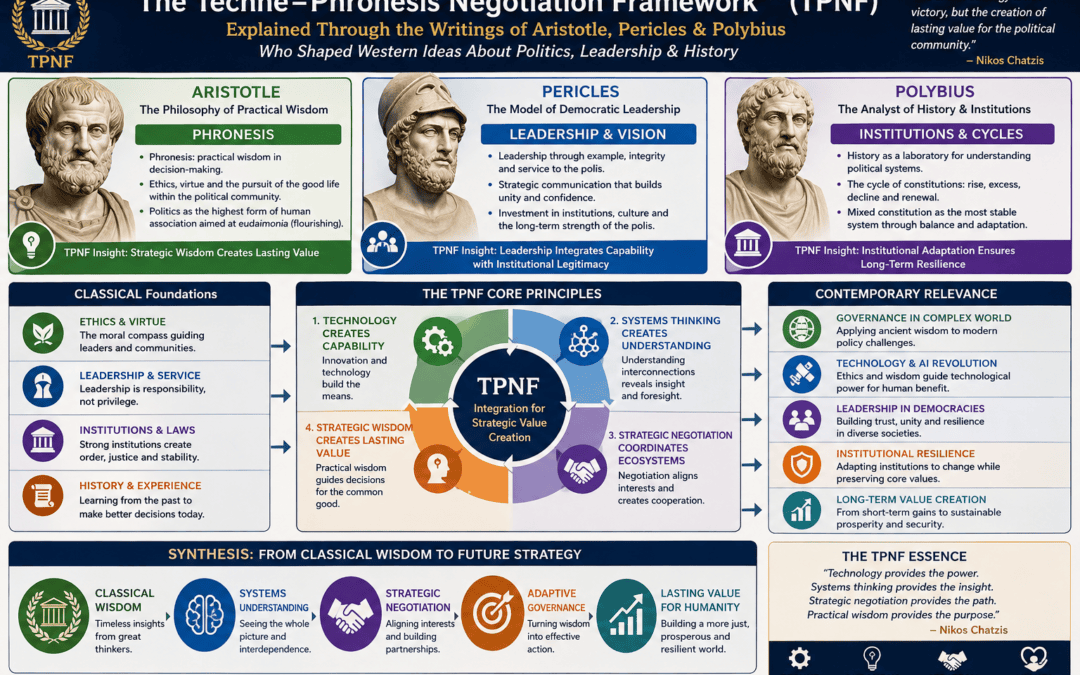
The Techne–Phronesis Negotiation Framework™ (TPNF) is deeply connected to the classical intellectual tradition that shaped Western strategic thought. The writings and ideas of Aristotle, Pericles, and Polybius continue to provide enduring insights into politics, leadership, governance, historical analysis, and institutional resilience. Through the analytical lens of TPNF, these classical contributions remain directly relevant to understanding the challenges of contemporary technological civilization.
Purpose of the Essay
This essay explores how Aristotle’s philosophy of practical wisdom, Pericles’ vision of democratic leadership, and Polybius’ analysis of political systems and historical cycles collectively illuminate the theoretical foundations of the Techne–Phronesis Negotiation Framework™ (TPNF). It argues that these classical thinkers provide complementary perspectives that help explain strategic adaptation, governance, institutional resilience, and long-term value creation in the twenty-first century.
Abstract
The rapid transformation of technological civilization often encourages leaders to focus on innovation while overlooking the enduring principles of strategic thought developed over two millennia ago. Yet many of today’s challenges—including governance, institutional legitimacy, leadership, geopolitical competition, and societal adaptation—were examined with remarkable depth by the great thinkers of classical antiquity.
The Techne–Phronesis Negotiation Framework™ (TPNF) reconnects these historical insights with contemporary strategic analysis. Rather than treating classical philosophy and history as intellectual heritage alone, TPNF views them as living analytical resources capable of guiding decision-making in increasingly complex technological ecosystems.
Introduction
Why Classical Political Thought Still Matters
Technologies evolve rapidly.
Human decision-making evolves far more gradually.
Artificial intelligence, autonomous systems, digital finance, cyber capabilities, and global connectivity have transformed the environment within which leaders operate.
However, leaders continue to confront familiar questions:
- How should power be exercised?
- What creates legitimate governance?
- How should institutions adapt?
- Why do political systems succeed or fail?
- How should societies prepare for long-term uncertainty?
Aristotle, Pericles, and Polybius each addressed different dimensions of these enduring questions.
Main Discussion
1. Aristotle: Practical Wisdom as Strategic Judgment
Among Aristotle’s most influential concepts is Phronesis—practical wisdom.
For Aristotle, effective leadership depended not simply upon knowledge but upon the capacity to make sound judgments within changing circumstances.
This principle directly informs TPNF.
The third principle of the framework states:
Strategic Wisdom Creates Lasting Value.
Technology may generate capability.
Knowledge may improve understanding.
Only practical wisdom determines how those capabilities should be used.
Aristotle therefore provides the philosophical foundation for TPNF.
2. Pericles: Leadership, Democracy, and Strategic Vision
Pericles demonstrated that leadership extends beyond military command.
His leadership emphasized:
- civic responsibility
- institutional confidence
- strategic communication
- democratic legitimacy
- long-term public investment
His vision transformed Athens into a center of political, economic, cultural, and naval power.
Within TPNF, Pericles illustrates that strategic leadership requires integrating technological capability with institutional legitimacy and societal trust.
3. Polybius: History as a Laboratory of Institutions
Polybius examined how political systems evolve.
His theory of constitutional cycles emphasized that institutions continuously adapt—or decline—in response to internal and external pressures.
Modern technological civilization exhibits similar dynamics.
Governments, corporations, universities, and international organizations continually adapt to:
- technological disruption
- geopolitical competition
- economic transformation
- demographic change
- artificial intelligence
Polybius reminds us that institutional resilience depends upon continuous adaptation.
| Classical Thinker | Core Classical Contribution | TPNF Interpretation | Contemporary Strategic Application |
|---|---|---|---|
| Aristotle | Phronesis (Practical Wisdom) | Strategic Wisdom Creates Lasting Value | Ethical leadership, AI governance, strategic decision-making, adaptive leadership |
| Pericles | Democratic leadership and long-term strategic vision | Leadership integrates capability with institutional legitimacy | National strategy, public trust, strategic communication, innovation policy |
| Polybius | Constitutional evolution and historical cycles | Institutional Adaptation & Systems Evolution | Adaptive governance, institutional resilience, organizational transformation |
| Techne (Classical Concept) | Technical knowledge and skilled capability | Technology Creates Capability | Artificial Intelligence, robotics, space systems, advanced manufacturing |
| Systems Perspective (derived from the interaction of all three) | Politics, institutions, leadership and history are interconnected | Systems Thinking Creates Understanding | Complex adaptive systems, ecosystem governance, strategic resilience |
| TPNF Synthesis | Integration of classical strategic thought | Technology + Systems Thinking + Strategic Negotiation + Practical Wisdom | Future Value Creation within Technological Civilization |
4. Systems Thinking Creates Understanding
The second principle of TPNF states:
Systems Thinking Creates Understanding.
Aristotle analyzed ethics within political communities.
Pericles integrated military, political, economic, and civic leadership.
Polybius examined interactions among constitutions, societies, and historical change.
Each recognized that political outcomes emerge through interconnected relationships rather than isolated decisions.
Systems thinking therefore extends rather than replaces classical political analysis.
5. Negotiation as Civic Coordination
Negotiation within TPNF extends far beyond diplomatic bargaining.
It coordinates:
- institutions
- governments
- alliances
- public interests
- technological ecosystems
- economic systems
Similarly, the political practices associated with classical Greece and the broader Hellenistic world required continuous negotiation among competing interests.
Stable governance depended upon balancing diverse perspectives.
CLASSICAL GREEK STRATEGIC THOUGHT
────────────────────────────────────────────────────────
Aristotle
(Practical Wisdom)
│
▼
PHRONESIS
│
│
Pericles ────┼──── Polybius
(Leadership) │ (Institutions)
│
▼
STRATEGIA
(Leadership • Governance • Adaptation)
────────────────────────────────────────────────────────
▼
TECHNE–PHRONESIS
NEGOTIATION FRAMEWORK™ (TPNF)
────────────────────────────────────────────────────────
▼
Technology Creates Capability
│
▼
Systems Thinking Creates Understanding
│
▼
Strategic Negotiation Coordinates Ecosystems
│
▼
Adaptive Governance & Institutional Resilience
│
▼
Strategic Wisdom Creates Lasting Value
│
▼
TECHNOLOGICAL CIVILIZATION
& FUTURE VALUE CREATION
6. Institutional Adaptation and Technological Civilization
The accelerating pace of technological change requires adaptive institutions.
Adaptive governance includes:
- organizational learning
- technological integration
- evidence-based policymaking
- institutional innovation
- strategic foresight
Aristotle, Pericles, and Polybius collectively demonstrate that institutional strength depends upon balancing continuity with adaptation.
7. Strategic Wisdom Creates Lasting Value
The final principle of TPNF synthesizes the contributions of these three thinkers.
Strategic wisdom balances:
- innovation with prudence
- capability with legitimacy
- competition with cooperation
- adaptation with institutional stability
- technological progress with ethical responsibility
These relationships ultimately determine long-term societal resilience.
Strategic Implications
The TPNF perspective suggests several important conclusions.
First, Aristotle provides the philosophical foundation of practical wisdom.
Second, Pericles demonstrates the importance of visionary democratic leadership and institutional legitimacy.
Third, Polybius explains why institutional adaptation determines long-term political resilience.
Fourth, systems thinking integrates these classical insights into contemporary technological civilization.
Finally, strategic negotiation enables institutions to coordinate increasingly complex adaptive ecosystems.
| TPNF Dimension | Aristotle | Pericles | Polybius |
|---|---|---|---|
| Philosophy | ★★★★★ | ★★★☆☆ | ★★★★☆ |
| Political Leadership | ★★★★☆ | ★★★★★ | ★★★☆☆ |
| Governance | ★★★★☆ | ★★★★★ | ★★★★★ |
| Institutional Analysis | ★★★☆☆ | ★★★☆☆ | ★★★★★ |
| Historical Analysis | ★★☆☆☆ | ★★★☆☆ | ★★★★★ |
| Practical Strategy | ★★★★☆ | ★★★★★ | ★★★★☆ |
| Ethical Judgment | ★★★★★ | ★★★★☆ | ★★★☆☆ |
| Systems Thinking | ★★★★☆ | ★★★★☆ | ★★★★★ |
| Relevance to TPNF | ★★★★★ | ★★★★★ | ★★★★★ |
Although separated from contemporary society by more than two thousand years, Aristotle, Pericles, and Polybius continue to illuminate many of the strategic questions confronting modern leaders. Their reflections on ethics, governance, institutional development, and historical change remain strikingly relevant in an era defined by technological acceleration and global interdependence.
The Techne–Phronesis Negotiation Framework™ (TPNF) extends this classical intellectual tradition by integrating technological capability, systems thinking, strategic negotiation, adaptive governance, and practical wisdom into a unified analytical framework. Rather than viewing classical political philosophy as historical legacy alone, TPNF demonstrates that its central insights remain essential for understanding and governing the complex adaptive ecosystems of technological civilization.
Key Takeaways
- Aristotle provides the philosophical foundation of Phronesis as practical strategic judgment.
- Pericles demonstrates the relationship between leadership, legitimacy, and long-term strategic vision.
- Polybius explains institutional adaptation and the dynamics of political systems.
- Systems thinking strengthens the relevance of classical political philosophy in technological civilization.
- TPNF integrates classical wisdom with modern technological ecosystems to explain sustainable value creation.
Author’s Reflection
Civilizations advance through innovation, but they endure through wisdom. The writings of Aristotle, Pericles, and Polybius remind us that technology, institutions, and political power achieve their highest purpose only when guided by sound judgment, ethical leadership, and adaptive governance. The Techne–Phronesis Negotiation Framework™ (TPNF) seeks to extend this enduring tradition by integrating classical political philosophy with the realities of technological civilization, demonstrating that lasting strategic value is created when innovation is continuously informed by practical wisdom.
Author: Nikos Chatzis
Source: Open Sources Analysis, Relative Data Analysis by Nikos Chatzis
© Nikolaos Chatzis. All Rights Reserved.
The Techne–Phronesis Negotiation Framework™
An Integrative Theory of Strategic Negotiation, Complex Adaptive Systems and Practical Wisdom
Technology Creates Capability • Systems Thinking Creates Understanding • Strategic Wisdom Creates Lasting Value.
Negotiation.gr | Strategic Wisdom for the Technological Age