Negotiation.gr | Strategic Wisdom for the Technological Age
“Strategic resilience emerges when technical capability (techne) is
continuously guided by practical wisdom (phronesis) through adaptive
negotiation across interconnected systems.”
Central Idea
The United States Navy’s pursuit of future carrier-based tactical unmanned aircraft capable of conducting strike missions at ranges of at least 1,000 nautical miles represents more than an extension of naval aviation. It signals a transition toward a multidimensional model of maritime power in which autonomous platforms, human decision-makers, aircraft carriers, satellites, sensors, weapons, allied forces, industrial partners, and digital command networks operate as an interconnected strategic ecosystem.
Through the Techne–Phronesis Negotiation Framework™ (TPNF), long-range carrier-based drones should therefore be understood not merely as individual weapons platforms, but as components of a complex adaptive system whose effectiveness depends upon technological capability, prudent judgment, systems integration, strategic negotiation, network resilience, and institutional adaptation.
Purpose
The purpose of this essay is to examine the strategic implications of the United States Navy’s interest in future carrier-based tactical drone fleets capable of conducting long-range strike, reconnaissance, electronic warfare, and supporting missions.
The essay applies the Techne–Phronesis Negotiation Framework™ (TPNF) to analyze how such unmanned systems may reshape carrier aviation, distributed maritime operations, alliance interoperability, defence-industrial cooperation, operational resilience, and network-centric warfare.
This analysis is strategic rather than operational. It does not advocate particular targeting decisions or provide instructions for employing weapons. Instead, it examines the institutional, technological, diplomatic, and systemic conditions required to transform long-range unmanned capability into sustainable strategic value.
TPNF Strategic Proposition
In contemporary technological civilization, geopolitical influence emerges from a state’s capacity to understand, coordinate, and adapt within multilevel network ecosystems that include both state and non-state actors operating across technological, economic, diplomatic, societal, and security domains.
Applied to naval warfare, this proposition suggests that the strategic value of a future unmanned carrier air wing will not be determined solely by aircraft range, payload, speed, stealth, or autonomy. It will depend upon the Navy’s capacity to coordinate the entire ecosystem through which information is collected, interpreted, transmitted, protected, negotiated, and transformed into legitimate strategic action.
Abstract
The United States Navy is exploring a new generation of carrier-based unmanned aircraft intended to provide affordable operational mass, increased range, autonomous functions, and multiple tactical capabilities. A July 2026 request for industry information reportedly identified a minimum strike-mission range of 1,000 nautical miles, alongside requirements involving carrier compatibility, dynamic tasking, threat avoidance, automated aerial refuelling, and integration with existing unmanned-aircraft control systems. The Navy also expressed interest in vertical-take-off platforms capable of operating from vessels other than aircraft carriers.
These requirements indicate that the future of carrier aviation is not centred upon a single drone design. It is moving toward a distributed family of manned and unmanned systems connected through digital, sensor, logistical, command, industrial, and alliance networks.
This essay applies the Techne–Phronesis Negotiation Framework™ (TPNF) to evaluate this transformation. It argues that long-range unmanned carrier aviation must be approached as a complex adaptive ecosystem in which technological capability must be coordinated through practical wisdom, systems thinking, strategic negotiation, multilevel institutional collaboration, and networked strategic resilience.
The strategic question is therefore not simply whether the United States can build a carrier-based drone capable of operating at extended range. The deeper question is whether the Navy and its partners can construct, govern, protect, and continually adapt the multidimensional network required to employ such systems responsibly and effectively.
Introduction
The aircraft carrier has historically represented the concentration of military power at sea. Its strategic influence has rested not only upon the ship itself, but upon the carrier air wing, escorting vessels, logistics ships, submarines, intelligence systems, maintenance infrastructure, shore facilities, and alliance relationships that support its operations.
Contemporary anti-access and area-denial capabilities have complicated this model. Long-range missiles, submarines, cyber operations, electronic warfare, space-based surveillance, unmanned platforms, and distributed sensor networks can place both carriers and their supporting systems under increasing pressure. Consequently, the effective range, survivability, flexibility, and composition of the carrier air wing have become central questions in the future of maritime strategy.
The Navy’s current interest in carrier-based unmanned aircraft reflects this changing environment. Its request reportedly seeks affordable and risk-tolerant platforms for missions that may include strike operations, surveillance, electronic warfare, aerial refuelling, communications support, and other functions. The request also refers to autonomous carrier operations, dynamic retasking, threat evasion, and automated aerial refuelling.
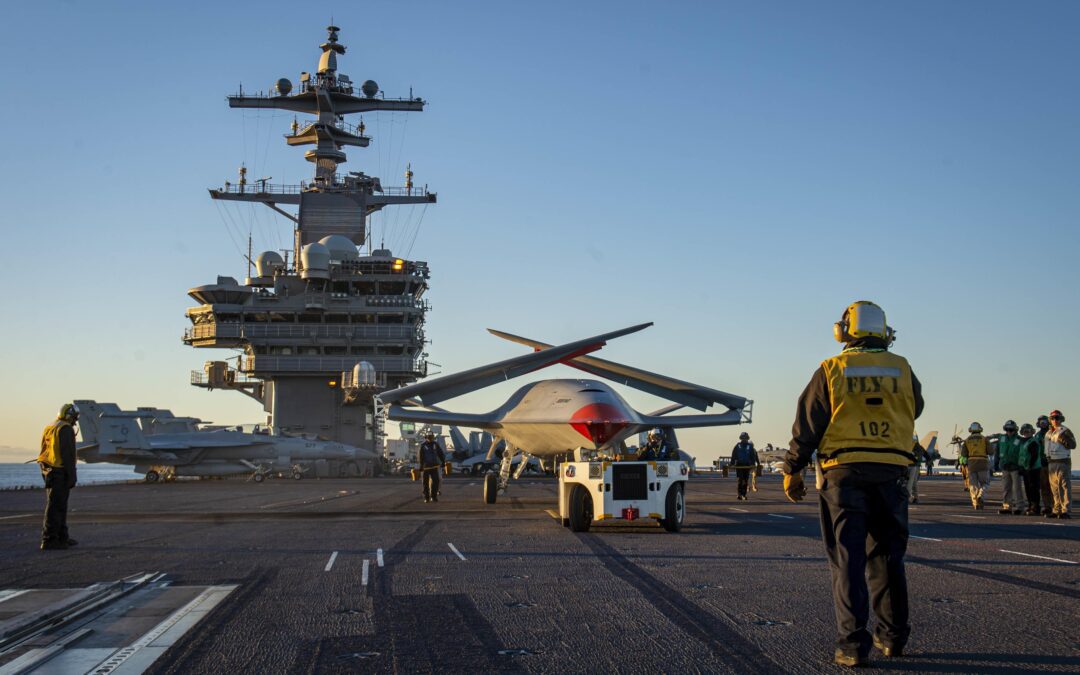
This initiative develops upon earlier unmanned aviation programmes. The MQ-25A Stingray, for example, is intended primarily to provide carrier-based aerial refuelling and thereby extend the reach of the existing carrier air wing. The Navy has described it as its first operational carrier-based unmanned aircraft, while the Department of the Navy’s Unmanned Campaign Framework has positioned it as an initial step toward a more distributed future force.
The new requirement, however, points toward a broader transformation. It suggests the emergence of tactical drone fleets rather than a single specialised unmanned aircraft. Such fleets may eventually combine different levels of cost, autonomy, survivability, payload capacity, range, and mission specialisation.
The Techne–Phronesis Negotiation Framework™ provides an appropriate methodology for interpreting this transformation because it integrates technological competence with practical wisdom, systemic understanding, strategic negotiation, institutional adaptation, and resilience.
From this perspective, the future carrier air wing is not simply an inventory of aircraft. It is a multilevel network ecosystem whose strategic performance emerges from relationships among platforms, personnel, institutions, technologies, allies, industries, legal frameworks, and operational environments.
1. From Platform-Centric Warfare to Network-Centric Warfare
Traditional discussions of naval aviation often focus on individual platform characteristics: speed, range, payload, radar signature, manoeuvrability, and weapons capacity. These attributes remain important, but they are insufficient for understanding contemporary maritime warfare.
A long-range unmanned aircraft cannot operate strategically in isolation. It depends upon networks that provide:
- Intelligence and surveillance;
- Positioning, navigation, and timing;
- Target identification and verification;
- Secure communications;
- Electronic-warfare support;
- Aerial refuelling;
- Mission planning and retasking;
- Carrier launch and recovery;
- Maintenance and software updates;
- Logistics and replacement components;
- Rules of engagement and command authority;
- Allied access and regional support.
Consequently, the decisive unit of analysis is no longer the aircraft alone. It is the entire network through which the aircraft receives information, interacts with other systems, and contributes to a wider strategic objective.
The Navy has explored such ideas for years. Earlier descriptions of the Navy Unmanned Combat Air System envisioned a carrier-based, networked, high-performance unmanned system integrated with emerging global command-and-control architectures.
The present concept advances that trajectory. A future unmanned carrier air wing could operate as a distributed constellation of sensors, communications nodes, electronic-warfare platforms, refuelling aircraft, reconnaissance systems, decoys, and strike-capable platforms.
This is the essence of network-centric warfare: strategic advantage emerges from the capacity to connect dispersed capabilities, generate shared situational awareness, accelerate decision-making, and coordinate action across multiple domains.
However, connectivity also creates dependency. A networked force may become vulnerable if communications, satellite services, data architecture, software, or decision chains are disrupted. The expansion of technological capability must therefore be accompanied by an equivalent expansion of strategic resilience.
2. Techne: The Architecture of Extended Naval Capability
Within the TPNF, Techne refers to organised technical knowledge, practical expertise, design capability, and the disciplined ability to construct and operate complex systems.
In the context of future carrier-based drone fleets, Techne includes considerably more than aircraft engineering. It encompasses:
- Autonomous flight and mission-management software;
- Carrier-compatible launch and recovery systems;
- Secure and resilient communications;
- Artificial intelligence and machine-assisted decision support;
- Low-observable design;
- Propulsion and fuel efficiency;
- Automated aerial refuelling;
- Electronic-warfare systems;
- Modular payload integration;
- Human-machine interfaces;
- Cybersecurity;
- Digital engineering and simulation;
- Maintenance, logistics, and supply-chain management.
The ambition to operate at or beyond 1,000 nautical miles substantially increases the demands placed on this technical architecture. Extended distance affects fuel requirements, communications latency, mission endurance, navigation, maintenance cycles, payload trade-offs, refuelling requirements, command relationships, and recovery contingencies.
The range requirement must therefore not be understood as a single engineering measurement. It becomes a systems-design problem.
The MQ-25 illustrates the systemic nature of extended reach. Its principal mission is aerial refuelling, enabling other carrier aircraft to operate farther from the carrier while reducing the requirement to use combat aircraft as improvised tankers. GAO reporting has also emphasised that the programme is intended to expand carrier-air-wing reach, although it has encountered acquisition and schedule challenges.
Future tactical drones would extend this logic from support to a wider range of missions. Yet technological sophistication alone cannot determine when, where, or how such capabilities should be employed.
That requires Phronesis.
3. Phronesis: Strategic Judgment in Autonomous Warfare
Phronesis is practical wisdom: the capacity to exercise sound judgment under conditions of uncertainty, competing values, incomplete information, and potentially irreversible consequences.
As unmanned systems gain autonomy, the importance of Phronesis increases rather than diminishes.
Autonomy can support navigation, carrier operations, threat avoidance, sensor management, formation coordination, refuelling, and dynamic mission adaptation. Nevertheless, technical capacity should not be confused with legitimate decision authority.
Commanders and political leaders must still determine:
- The strategic purpose of a mission;
- The acceptable level of escalation risk;
- The reliability of intelligence;
- The legal basis for action;
- The distinction between military necessity and technological opportunity;
- The appropriate balance between human control and machine autonomy;
- The political implications of losing or recovering an unmanned platform;
- The risks of software error, manipulation, or misidentification;
- The proportionality and legitimacy of force;
- The long-term consequences for regional stability.
The absence of a pilot onboard may reduce immediate risk to military personnel, but it can also alter political perceptions of risk. Leaders may consider unmanned operations easier to authorise because no crew is directly exposed. Conversely, an adversary may interpret the deployment of large unmanned formations as preparation for a major strike.
Phronesis therefore requires decision-makers to evaluate not only what a system can do, but what it ought to do within a particular strategic context.
The TPNF rejects technological determinism. Technology expands the field of possible action, but practical wisdom must govern the selection of action.
4. The 1,000-Nautical-Mile Requirement as a Systems Problem
The attraction of extended range is strategically understandable. Aircraft capable of operating farther from the carrier can increase geographical reach and potentially reduce the carrier’s exposure to some categories of threat.
Yet distance does not automatically create security.
An aircraft operating 1,000 nautical miles from its carrier may still depend upon vulnerable communications, tankers, satellites, forward sensors, regional access agreements, and maintenance infrastructure. Its mission effectiveness may also depend upon information supplied by forces belonging to another military service or allied state.
Thus, the relevant question is not merely:
How far can the drone fly?
The more important questions are:
How far can the network sense, understand, decide, communicate, sustain, and adapt?
A nominal range figure can become misleading when separated from payload, mission profile, fuel reserve, aerial refuelling, threat environment, and recovery requirements. “Range” may describe the total distance an aircraft can travel, while “combat radius” normally concerns the distance at which it can conduct a mission and return under defined conditions. The public reporting on the July 2026 request refers specifically to a minimum 1,000-nautical-mile range for strike missions; it should not automatically be treated as an identical 1,000-nautical-mile unrefuelled combat radius.
The TPNF therefore interprets the requirement as an ecosystem objective rather than a platform specification.
Its successful implementation would require coordination across:
- Aircraft design;
- Carrier-deck operations;
- Refuelling architecture;
- Sensors and targeting;
- Command-and-control networks;
- Electronic protection;
- Logistics;
- Software assurance;
- Training;
- Doctrine;
- Alliance interoperability;
- Political authorisation.
This transforms range from an engineering variable into a strategic governance challenge.
5. Tactical Drone Fleets and Affordable Operational Mass
The Navy’s reported request emphasises affordable mass and risk-tolerant platforms. This language suggests a potential shift from a small number of extremely expensive aircraft toward a mixed force containing systems with different levels of cost, survivability, autonomy, and mission specialisation.
A future carrier air wing might therefore include:
- Highly survivable crewed aircraft;
- Advanced autonomous combat aircraft;
- Lower-cost collaborative drones;
- Refuelling drones;
- Electronic-warfare platforms;
- Surveillance and targeting aircraft;
- Communications-relay drones;
- Decoys;
- Vertical-take-off systems operating from other naval vessels.
The strategic objective would not necessarily be to replace crewed aviation. It would be to create a flexible human-machine ecosystem capable of distributing risk and generating operational effects through coordinated diversity.
Affordable mass could provide several advantages:
First, it could complicate an adversary’s targeting and defensive planning.
Second, it could permit the Navy to accept losses that would be politically, financially, or operationally prohibitive with high-value crewed aircraft.
Third, it could expand the number of sensors and communications nodes available across a maritime theatre.
Fourth, it could enable commanders to tailor force packages to different missions rather than relying on a limited set of multi-role platforms.
Nevertheless, affordability must be assessed across the system’s full life cycle. A relatively inexpensive aircraft may still require costly software, secure communications, specialised maintenance, carrier modifications, training, weapons integration, data infrastructure, and supply-chain support.
Affordable mass is therefore not simply a procurement category. It is an ecosystem property.
6. Complex Adaptive Systems and Adversarial Response
The maritime security environment is a complex adaptive system. Every major technological innovation generates countermeasures, doctrinal adjustments, institutional learning, and new patterns of behaviour.
Potential adversaries will not passively observe the development of long-range carrier drones. They may adapt by improving:
- Long-range air defence;
- Electronic warfare;
- Cyber operations;
- Space and counter-space capabilities;
- Deception;
- Camouflage and concealment;
- Mobile targeting;
- Undersea warfare;
- Long-range interception;
- Counter-autonomy systems;
- Attacks against logistics and communications networks.
This creates a continuous cycle of adaptation.
A drone fleet designed around uninterrupted satellite communications may face jamming or satellite degradation. A formation dependent upon centralised command may encounter communications denial. An autonomous system trained against known threat patterns may confront deception or unfamiliar tactical behaviour.
The strategic value of the fleet will consequently depend upon its capacity to learn and reorganise.
Within the TPNF, adaptation requires:
- Modular software and payloads;
- Redundant communications;
- Distributed decision authority;
- Multiple navigation methods;
- Human-machine teaming;
- Continuous experimentation;
- Rapid feedback from operations;
- Institutional openness to doctrinal revision;
- Procurement processes capable of incorporating technological change.
A fixed platform may quickly become strategically outdated. An adaptive ecosystem can absorb change and continue producing value.
7. Multilevel Network Ecosystems
The development and employment of future carrier-based drones will involve a wide range of actors operating at different levels.
Governmental and Military Actors
These include:
- The United States Navy;
- The Department of Defense;
- Combatant commands;
- The Marine Corps, Air Force, Army, and Space Force;
- Congress;
- Intelligence agencies;
- Allied defence ministries;
- Partner navies and air forces.
Industrial and Technological Actors
These include:
- Aircraft manufacturers;
- Shipbuilders;
- Software companies;
- Artificial-intelligence developers;
- Communications providers;
- Semiconductor producers;
- Sensor and weapons manufacturers;
- Cybersecurity companies;
- Maintenance and logistics contractors.
Knowledge and Research Actors
These include:
- Universities;
- Naval research laboratories;
- War colleges;
- Think tanks;
- Testing organisations;
- Standards bodies;
- Independent technical experts.
International and Societal Actors
These include:
- Alliance institutions;
- International organisations;
- National legislatures;
- Legal communities;
- Civil society;
- Media;
- Communities hosting military infrastructure.
Disruptive actors—including cyber groups, espionage networks, transnational criminal organisations, and hostile non-state armed groups—may also influence programme security and operational effectiveness. They are components of the analytical ecosystem because they can affect outcomes, but they are not equivalent in legitimacy to governments, alliances, research institutions, or civil society organisations.
The Navy must therefore coordinate a multilevel ecosystem extending far beyond the flight deck.
8. Strategic Negotiation and Alliance Interoperability
The future drone fleet will require continuous strategic negotiation.
This negotiation will occur within the United States government over budgets, programme priorities, acquisition risk, force structure, and the balance between crewed and unmanned aviation.
It will occur between the Navy and industry over:
- Intellectual property;
- Software access;
- Technical standards;
- Cost;
- Production capacity;
- Maintenance responsibilities;
- Cybersecurity;
- Upgrade pathways;
- Data ownership.
It will also occur among allies.
Long-range naval operations may depend upon allied airspace, bases, maintenance facilities, communications systems, intelligence, refuelling support, or political consent. Interoperability will require agreement concerning technical standards, information sharing, command relationships, mission authority, and rules of engagement.
Allied states may support the broader objective while disagreeing about particular uses of autonomous systems. Some may impose stronger legal or political restrictions on machine-assisted targeting. Others may be reluctant to share sensitive data or permit operations from their territory during a crisis.
Strategic negotiation must therefore precede technological integration.
Interoperability cannot be improvised after a crisis begins. It must be constructed through exercises, agreements, common standards, institutional trust, and sustained political dialogue.
9. Human-Machine Command and the Negotiation of Authority
Autonomous military systems create a fundamental governance question:
Which decisions may be delegated to machines, and which must remain under meaningful human authority?
This is not merely a technical matter. It is a negotiation among commanders, engineers, lawyers, political leaders, operators, allies, and societies.
Different missions may require different levels of autonomy.
Automated carrier landing may be broadly accepted because the system executes a defined aviation function. Automated threat avoidance may involve a more dynamic tactical judgment. Dynamic retasking introduces questions about who authorises changes in mission. Weapon employment raises further legal, ethical, and strategic concerns.
A resilient command model must clarify:
- Who establishes mission objectives;
- Who validates targets;
- Who may retask an aircraft;
- What the system may do when communications are lost;
- When it must return, hold, or terminate a mission;
- How human operators can intervene;
- How decisions are recorded and reviewed;
- Who is accountable for errors or unintended effects
- How decisions are recorded and reviewed;
- Who is accountable for errors or unintended effects.
The goal should not be to maximise autonomy as an abstract technological achievement. It should be to allocate decision authority in ways that improve performance while preserving legitimacy, accountability, and strategic control.
10. Networked Strategic Resilience
The tactical advantage of a drone fleet will be limited if its networks are fragile.
Networked Strategic Resilience refers to the capacity of interconnected systems and institutions to absorb disruption, reorganise, adapt, and continue pursuing legitimate strategic objectives.
For long-range carrier-based operations, resilience should include:
Communications Resilience
Aircraft should not depend upon a single communications pathway. Networks must be able to shift among satellite, airborne, ship-based, line-of-sight, and other secure channels.
Navigation Resilience
Systems must be capable of operating under degraded positioning and timing conditions.
Cyber Resilience
Software, mission data, maintenance systems, and control networks require protection from intrusion, manipulation, and supply-chain compromise.
Operational Resilience
Drone formations should continue functioning when individual platforms or nodes are lost.
Logistical Resilience
The fleet must be sustained through dispersed maintenance, spare parts, fuel, weapons, software, and trained personnel.
Institutional Resilience
Organisations must be able to learn from failure, revise doctrine, and integrate technological change without becoming paralysed by rigid procedures.
Alliance Resilience
Coalitions require shared standards, trust, information-sharing mechanisms, and alternative support arrangements when individual partners are constrained.
The Navy’s Unmanned Campaign Framework has already connected unmanned systems with the concept of a distributed future force. The next challenge is to ensure that distribution produces resilience rather than fragmentation.
11. The Carrier as a Network Orchestrator
The emergence of long-range unmanned aircraft does not necessarily make the aircraft carrier obsolete. It may transform its function.
Instead of serving only as a floating airfield for a predominantly crewed air wing, the carrier may increasingly operate as:
- A command-and-control centre;
- A human-machine integration hub;
- A data-processing node;
- A logistics and maintenance base;
- A launch-and-recovery platform for heterogeneous aircraft;
- A coordinator of distributed maritime operations.
The carrier’s strategic value would therefore derive from its capacity to orchestrate a wider network of systems, some operating from the carrier and others from destroyers, mobile sea bases, shore installations, or allied territory.
The Navy’s reported interest in vertical-take-off unmanned systems capable of operating from air-capable ships other than carriers reinforces this distributed interpretation.
The future naval aviation ecosystem may thus become less centred upon a single platform while remaining organised around the carrier as an important coordinating node.
12. Strategic Risks
The development of long-range carrier drone fleets creates significant strategic opportunities, but it also introduces risks.
Technological Overconfidence
Decision-makers may assume that autonomy, stealth, or range can overcome all operational constraints.
Network Dependency
The fleet may become excessively dependent upon communications, software, satellites, and external data.
Escalation Ambiguity
Large unmanned formations may be interpreted as preparation for attack, even when deployed for surveillance or deterrence.
Acquisition Complexity
Combining new aircraft, software, autonomy, carrier integration, weapons, and communications can produce cost growth and schedule delays. The MQ-25 programme demonstrates that pioneering carrier-based unmanned aviation can encounter substantial acquisition challenges.
Industrial Concentration
Dependence upon a small number of suppliers may create production and supply-chain vulnerabilities.
Ethical and Legal Uncertainty
Insufficiently defined human-control arrangements can undermine legitimacy and alliance cohesion.
Adversarial Adaptation
Countermeasures may reduce the advantage of a system before it reaches full operational maturity.
Organisational Resistance
Established aviation communities may resist changes to roles, career structures, doctrine, and resource allocation.
These risks do not invalidate the initiative. They demonstrate the need for systemic governance and practical wisdom.
13. A TPNF Strategic and Tactical Plan of Action™
A TPNF-based approach would organise the Navy’s transformation through the following phases.
Phase I — Strategic Situation Assessment
Clarify the strategic problems the drone fleet is intended to address. Range should be connected to defined missions, theatres, threat conditions, alliance commitments, and political objectives.
Phase II — Ecosystem Mapping
Identify all military, governmental, industrial, academic, allied, technological, legal, and societal actors whose decisions affect the programme.
Phase III — Strategic Intelligence Assessment
Evaluate adversarial capabilities, adaptation pathways, technological trends, supply-chain vulnerabilities, operational geography, and alliance constraints.
Phase IV — Strategic Negotiation Assessment
Identify internal and external negotiations involving budgets, acquisition, industrial responsibilities, data sharing, access, interoperability, command authority, and human control.
Phase V — Systems Thinking Assessment
Examine interactions among aircraft, carriers, escort ships, satellites, tankers, sensors, weapons, software, logistics, doctrine, personnel, and political decision structures.
Phase VI — Complex Adaptive Systems Assessment
Develop multiple scenarios reflecting adversarial adaptation, communications disruption, technological failure, alliance disagreement, logistical pressure, and strategic surprise.
Phase VII — Strategic Options
Compare alternative force designs, including highly capable autonomous aircraft, mixed-cost fleets, collaborative drones, carrier-launched systems, and vertical-take-off platforms distributed across several ship classes.
Phase VIII — Tactical Plan of Action™
Immediate Priorities
Establish common terminology, define mission categories, clarify human-control principles, and construct a shared digital architecture.
Thirty-Day and Near-Term Priorities
Deepen industry consultation, identify technological bottlenecks, conduct simulation-based experimentation, and expand allied dialogue.
Six-Month Priorities
Test mixed manned-unmanned formations, contested communications, automated refuelling, distributed control, and alternative recovery procedures.
One-to-Five-Year Priorities
Build an interoperable family of systems, expand production capacity, create resilient supply chains, reform training and career pathways, and institutionalise continuous adaptation.
Phase IX — Strategic Resilience Assessment
Test whether the system can continue operating under cyberattack, communications loss, satellite degradation, aircraft attrition, carrier damage, supply disruption, and allied-access restrictions.
Phase X — Strategic Value Creation
Assess whether the programme generates sustainable strategic value through deterrence, operational flexibility, reduced personnel exposure, alliance cohesion, industrial innovation, and responsible technological governance.
Strategic Implications
The U.S. Navy’s interest in 1,000-nautical-mile carrier-based drone operations has at least six broader strategic implications.
First, range is becoming a property of the network rather than the aircraft alone. Effective reach depends upon sensors, communications, refuelling, logistics, targeting, command, and alliance access.
Second, the future carrier air wing will likely be heterogeneous. Crewed aircraft, advanced autonomous systems, lower-cost drones, tankers, electronic-warfare platforms, and distributed vertical-take-off systems may operate together.
Third, affordable mass will require institutional change. Procurement, maintenance, training, doctrine, and command structures designed for small numbers of expensive aircraft may not suit larger unmanned fleets.
Fourth, autonomy will increase the importance of human judgment. The more technical functions machines can perform, the more carefully leaders must define strategic purpose, authority, accountability, and acceptable risk.
Fifth, alliance interoperability will become a negotiated strategic capability. Shared technology will not automatically create shared political consent or common rules of employment.
Sixth, resilience will be more important than perfect connectivity. A force that performs exceptionally under ideal network conditions but collapses when disrupted will not provide sustainable strategic value.
The United States Navy’s pursuit of future carrier-based tactical drone fleets capable of conducting strike missions at ranges of at least 1,000 nautical miles represents a potentially important transformation in maritime power. Yet its significance cannot be reduced to range, autonomy, payload, or aircraft design.
The emerging system must be understood as a multidimensional network of aircraft, carriers, surface vessels, satellites, sensors, weapons, software, communications, logistics, industries, institutions, allies, political authorities, and human decision-makers.
Through the Techne–Phronesis Negotiation Framework™, the programme reveals the inseparability of technological capability and practical wisdom.
Techne creates the aircraft, autonomy, sensors, networks, and supporting infrastructure.
Phronesis determines how those capabilities should be governed and employed amid uncertainty, escalation risk, legal responsibility, and competing strategic objectives.
Systems Thinking reveals that extended range is produced by interacting technical, organisational, and political systems.
Complex Adaptive Systems analysis recognises that adversaries, allies, institutions, and technologies will continually evolve in response to one another.
Strategic Negotiation coordinates the interests of military services, government institutions, industrial partners, allies, legal authorities, and societies.
Networked Strategic Resilience ensures that the resulting force can absorb disruption, reorganise, and continue pursuing legitimate strategic objectives.
he decisive strategic challenge is therefore not simply to develop a drone that can travel 1,000 nautical miles. It is to build a naval ecosystem capable of sensing, deciding, communicating, sustaining, negotiating, and adapting across that distance.
The aircraft carrier of the future may remain a powerful symbol of national capability, but its influence will increasingly derive from its position within a multilevel network ecosystem. Its strategic effectiveness will depend upon its ability to coordinate crewed and unmanned systems across maritime, air, space, cyber, industrial, diplomatic, and alliance domains.
In contemporary technological civilization, military power cannot be separated from the networks that create, support, govern, and legitimise it. Long-range carrier-based drones may generate important new capabilities, but only prudent strategic judgment can transform those capabilities into sustainable strategic value.
Source: Open Sources Analysis, Relative Data Analysis by Nikos Chatzis
© Nikolaos Chatzis. All Rights Reserved.
The Techne–Phronesis Negotiation Framework™
An Integrative Theory of Strategic Negotiation, Complex Adaptive Systems & Practical Wisdom
Technology Creates Capability • Systems Thinking Creates Understanding • Strategic Wisdom Creates Lasting Value.
Negotiation.gr | Strategic Wisdom for the Technological Age