Abstract
The twenty-first century is witnessing a profound transformation in the foundations of international power. While geography, military capability, natural resources, and economic strength have historically shaped international relations, technological innovation has emerged as a decisive factor influencing geopolitical competition, economic resilience, diplomatic influence, and national security. Emerging technologies such as Artificial Intelligence, semiconductors, quantum computing, autonomous systems, geospatial intelligence, biotechnology, cybersecurity, and space technologies no longer evolve in isolation. They develop within interconnected innovation ecosystems that integrate governments, universities, research institutions, technology companies, investors, regulatory authorities, and international organizations.
This thesis introduces the concept of the Geopolitics of Emerging Technology Ecosystems as a new analytical framework for understanding how technological innovation reshapes international relations. Rather than viewing technology as a collection of individual inventions, this perspective recognizes that the true sources of geopolitical influence increasingly lie in the ability of nations to build, govern, and strategically leverage collaborative innovation ecosystems.
Introduction
International relations are entering a new technological era.
The central question facing governments is no longer simply who possesses the largest military forces or the strongest economy.
Increasingly, the decisive question becomes:
Who controls the ecosystems that generate the technologies shaping the future?
Artificial Intelligence, quantum computing, advanced semiconductors, autonomous systems, geospatial intelligence, biotechnology, and space technologies have become strategic assets whose influence extends far beyond economic productivity.
Technology now determines:
- national competitiveness,
- geopolitical influence,
- military modernization,
- diplomatic leverage,
- industrial resilience,
- global governance.
This transformation requires a broader conceptual framework.
The Geopolitics of Emerging Technology Ecosystems provides such a framework.
Defining the Geopolitics of Emerging Technology Ecosystems
The Geopolitics of Emerging Technology Ecosystems may be defined as:
The study of how nations, international organizations, industries, research institutions, and innovation networks compete and cooperate to develop, govern, and strategically employ emerging technologies in pursuit of economic prosperity, national security, geopolitical influence, and sustainable international development.
Unlike traditional geopolitics, which focused primarily on geography and military power, this perspective recognizes that innovation ecosystems themselves have become strategic assets.
Power increasingly derives from the ability to organize collaboration rather than merely accumulate resources.
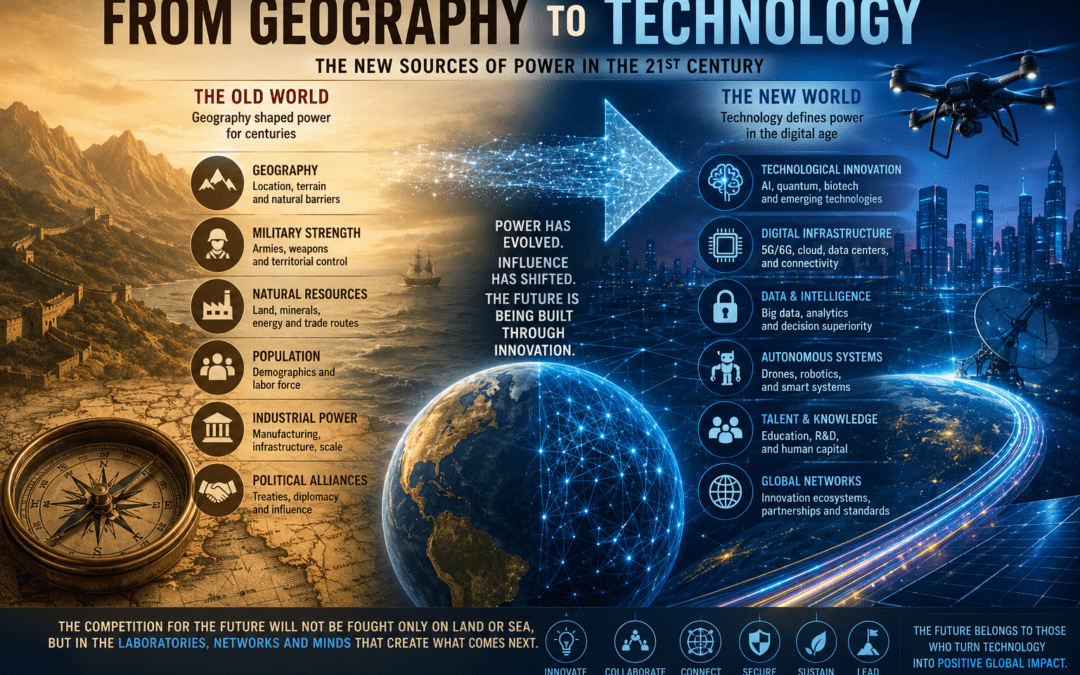
From Geography to Technology
Classical geopolitical thinkers emphasized:
- territory,
- maritime power,
- population,
- industrial capacity,
- military strength.
These remain important.
However, technological innovation increasingly determines the effectiveness of each of these traditional sources of power.
Artificial Intelligence influences military decision-making.
Semiconductors enable digital economies.
Quantum computing promises new strategic capabilities.
Cybersecurity protects national infrastructure.
Space technologies support communications and intelligence.
Technology has become the multiplier of geopolitical power.
Innovation Ecosystems as National Strategic Assets
Technological leadership no longer depends upon individual companies alone.
It depends upon innovation ecosystems composed of:
- universities,
- startups,
- multinational corporations,
- research laboratories,
- governments,
- investors,
- regulatory institutions,
- international partners.
The quality of interactions among these actors increasingly determines national competitiveness.
Countries capable of building resilient innovation ecosystems gain significant advantages in economic growth, technological sovereignty, and international influence.
Emerging Technologies Redefining International Relations
Several technological domains illustrate this transformation.
Artificial Intelligence is reshaping economic productivity, defense, and diplomacy.
Semiconductors have become the foundation of digital sovereignty.
Quantum technologies promise revolutionary advances in computing and secure communications.
Autonomous systems redefine transportation, manufacturing, and military operations.
Geospatial intelligence transforms decision-making across civilian and defense sectors.
Cybersecurity has become essential to protecting national resilience.
Each of these technologies influences geopolitical dynamics because each depends upon globally interconnected innovation ecosystems.
Strategic Competition and International Cooperation
The evolution of technology simultaneously encourages competition and cooperation.
Nations compete for:
- technological leadership,
- critical supply chains,
- research talent,
- intellectual property,
- industrial capacity.
At the same time, scientific research, standardization, climate technologies, and global digital infrastructure require international collaboration.
The resulting international environment is characterized by competitive cooperation.
Technology ecosystems therefore become arenas where geopolitical competition and international partnership coexist.
Technology Diplomacy
Technology diplomacy has emerged as one of the defining practices of the digital age.
Governments increasingly negotiate issues involving:
- Artificial Intelligence governance,
- semiconductor supply chains,
- cybersecurity,
- digital infrastructure,
- space technologies,
- autonomous systems.
Technology diplomacy extends beyond governments.
Universities, multinational corporations, research organizations, and innovation clusters increasingly participate in shaping international technological governance.
Diplomacy itself becomes an ecosystem activity.
The Drone Economy as an Illustrative Example
The global drone industry demonstrates the practical relevance of this framework.
Modern UAV ecosystems integrate:
- Artificial Intelligence,
- geospatial intelligence,
- satellite navigation,
- cloud computing,
- telecommunications,
- cybersecurity,
- advanced manufacturing,
- regulatory governance.
Civilian and defense applications increasingly overlap.
Innovation depends not upon aircraft alone but upon collaborative ecosystems spanning multiple industries and nations.
Drone technology therefore illustrates how emerging technologies reshape both economic development and geopolitical competition.
Strategic Negotiation and Ecosystem Governance
As innovation ecosystems become more complex, strategic negotiation acquires growing importance.
Governments, companies, universities, and international organizations must negotiate:
- research partnerships,
- technology transfer,
- investment,
- intellectual property,
- digital standards,
- international regulations,
- public-private cooperation.
Traditional transactional negotiation becomes insufficient.
The challenge shifts toward ecosystem governance.
Professionals capable of designing collaborative innovation environments become increasingly valuable.
This gives rise to the concept of the Technology Ecosystem 3D Negotiator!
Looking Toward the Future
During the coming decades, geopolitical influence will increasingly depend upon:
- innovation capacity,
- technological ecosystems,
- international partnerships,
- research excellence,
- strategic negotiation,
- technology diplomacy,
- ecosystem resilience.
Competition among nations will increasingly focus upon ecosystem quality rather than industrial production alone.
Countries capable of integrating technology, education, governance, diplomacy, and entrepreneurship into coherent innovation ecosystems will shape the future international order.
The Geopolitics of Emerging Technology Ecosystems represents an emerging analytical framework for understanding the transformation of international relations in the digital age.
Technology is no longer simply an economic resource.
It has become an organizing principle of geopolitical power.
Innovation ecosystems increasingly determine national competitiveness, strategic autonomy, diplomatic influence, and global governance.
Understanding these ecosystems requires integrating insights from geopolitics, international relations, economics, innovation management, technology diplomacy, and strategic negotiation.
The future international order will be shaped not solely by those who invent new technologies, but by those who build, govern, and strategically connect the ecosystems that enable innovation to flourish. In this emerging landscape, technology ecosystems become the new geography of global power.
Source: Open Sources Analysis, Relative Data Analysis by Nikos Chatzis