Negotiation.gr | Strategic Wisdom for the Technological Age
“Strategic resilience emerges when technical capability (techne) is
continuously guided by practical wisdom (phronesis) through adaptive
negotiation across interconnected systems.”
Abstract
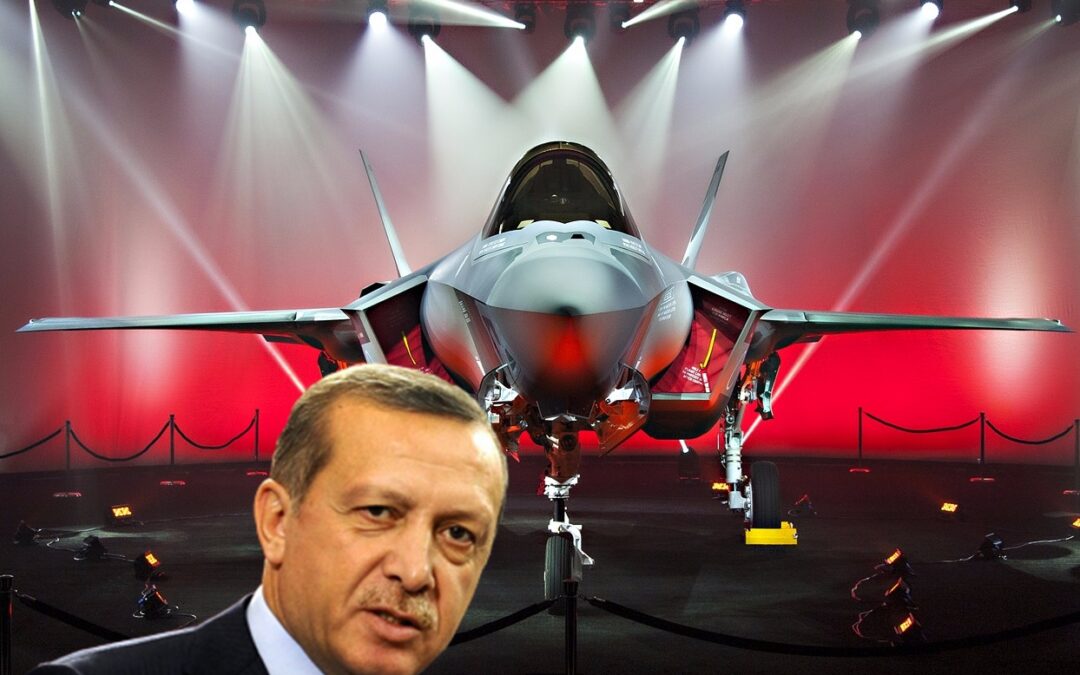
The possible transfer of Turkey’s Russian-made S-400 air-defence systems to a third country, followed by the removal of American sanctions and the eventual delivery of F-35 aircraft to Turkey, would represent a major alteration of the military balance in the Eastern Mediterranean. It would not automatically give Ankara decisive superiority over Greece or Israel, but it would substantially increase Turkey’s capacity for stealth penetration, intelligence collection, electronic warfare and long-range precision operations.
For Greece, the correct response would not be an attempt to prevent Turkey’s acquisition through diplomatic protest alone. Athens should pursue a combined strategy of conditional engagement with Washington, accelerated military modernisation, alliance institutionalisation, operational resilience and the transformation of Greece into an indispensable logistical, energy and commercial node. For the United States, an unconditional F-35 transfer to Turkey would carry considerable long-term risks. A strictly conditional and reversible arrangement might temporarily strengthen NATO’s southern flank, but an inadequately controlled transfer could weaken Israeli security, Greek deterrence, congressional authority and confidence in American security guarantees.
1. The immediate issue: S-400 disposal and Turkish access to the F-35
Turkey was removed from the F-35 programme in 2019 after receiving the Russian S-400 system. The central American objection was not merely political. Washington argued that the simultaneous presence of the S-400 and F-35 could expose sensitive information about the aircraft’s radar signature, electronic emissions and operational characteristics to Russian systems or personnel.
The current negotiation therefore concerns more than the physical location of the S-400 batteries. American authorities would need credible evidence that Turkey no longer possesses, controls, operates or can recover the systems, and that Russian technicians, software and intelligence channels no longer have access to Turkish defence networks. Current American law continues to prohibit Turkey’s return to the programme while it possesses the S-400. Secretary of State Marco Rubio has publicly acknowledged that the executive branch is constrained by statute, while Vice-President J.D. Vance has confirmed that the administration is examining whether the necessary legal certifications can be made.
A transfer to a Gulf state would therefore not, by itself, resolve the problem. Washington would have to establish that the transaction is genuine rather than a custodial arrangement that leaves Ankara with technical access, ownership rights or a path to future recovery. The identity of the recipient would also matter. A transfer to a country with close Turkish or Russian defence relations could be viewed in Congress as circumvention rather than elimination of the security risk.
President Trump’s declared willingness to lift sanctions is politically important, but it does not constitute a completed F-35 transaction. Congress retains legislative, appropriations and arms-transfer powers, and bipartisan opposition remains active.
2. Two American approaches, but not two separate governments
The apparent contradiction in American policy reflects different definitions of United States interests.
The first approach is transactional and presidential. It views Turkey as a large NATO state controlling the Straits, possessing a significant defence industry, maintaining influence in the Black Sea, the Caucasus, Syria, Central Asia and the Middle East, and capable of contributing military power quickly. In this interpretation, bringing Turkey back into the F-35 ecosystem could reduce Ankara’s dependence on Russian equipment, lock the Turkish Air Force into American logistics and software, create contracts for American industry and prevent Turkey from moving further towards Russia or China.
Trump’s position appears close to this logic. Vance’s support for a legal review similarly indicates that the White House is actively searching for a compliant route to a sale. However, Vance should not simply be characterised as “opposed to American involvement in Israel.” He has criticised Israeli actions and warned Israeli leaders against obstructing American policy, while also describing the United States as Israel’s indispensable ally. His position is better understood as an America-first insistence that Israel should not exercise a veto over decisions made by the American president.
The second approach is institutional and risk-oriented. It is represented by statutory restrictions, congressional opposition, sections of the Departments of State and Defense and constituencies concerned with Israel’s qualitative military edge, Russian counter-intelligence risks and Turkish unpredictability. Rubio’s position is not necessarily evidence of opposition to Turkey as such. His public argument is principally that the administration cannot disregard legislation linking F-35 eligibility to the removal of the S-400 problem.
Thus, the American division is between:
- geopolitical recovery of Turkey;
- legal and technological protection of the F-35;
- preservation of Israel’s qualitative military edge;
- reassurance of Greece and other regional partners; and
- presidential freedom of action versus congressional control.
3. Why Israel objects
Israel’s concern goes beyond the possibility of Turkish aircraft attacking Israeli territory. F-35 ownership would expand Turkey’s ability to conduct persistent intelligence, surveillance, targeting and electronic operations across Syria, Cyprus and the Eastern Mediterranean. It could complicate Israeli operations against Iranian-linked infrastructure and reduce Israel’s freedom of action in contested airspace.
Israel also distrusts the political direction of the Erdoğan government, Turkey’s support for Hamas-linked actors, its confrontational rhetoric and its competition with Israel in Syria and the wider region. Prime Minister Benjamin Netanyahu has publicly opposed an F-35 transfer, arguing that Turkey is not presently a friendly state and that the sale would affect the regional balance.
American law and policy traditionally require attention to Israel’s qualitative military edge. This does not give Israel an absolute legal veto over every sale, but it obliges Washington to consider whether advanced weapons supplied to another Middle Eastern state could undermine Israel’s military superiority.
Israel could theoretically be compensated with more advanced software, weapons, electronic-warfare capabilities, additional aircraft or privileged access to future upgrades. Nevertheless, compensation would not eliminate the political risk that two American-equipped regional powers might eventually confront one another.
4. Is Turkey’s geopolitical importance declining?
Turkey’s geographical value has not disappeared. It continues to control access between the Black Sea and the Mediterranean, occupies a central position between Europe, Russia and the Middle East, hosts important NATO facilities and has significant influence in Syria, Iraq, the Caucasus and Central Asia.
What has declined is not Turkey’s geography but its former geographical monopoly.
During earlier decades, Washington often treated Turkey as the indispensable southeastern anchor of NATO. Today, the United States and its partners possess alternative or complementary networks:
- Greece provides facilities at Souda Bay, Alexandroupolis and other locations.
- Alexandroupolis and northern Greek infrastructure support energy and military connectivity towards Bulgaria, Romania and the wider Black Sea region.
- The Vertical Gas Corridor strengthens Greece’s role as an entry point for LNG moving towards Central and Eastern Europe and Ukraine.
- Greece, Cyprus, Israel, Egypt and the Gulf states participate in overlapping energy, defence and commercial relationships.
- IMEC offers a prospective India–Gulf–Europe connectivity architecture in which Greek ports can compete for a European gateway function, although Greece is not an original state signatory.
- India, Israel and the UAE have developed strategic relationships that do not depend entirely on Turkish territory.
5. The military consequences for Greece
A Turkish F-35 acquisition would create a serious challenge, particularly during the period before Greece fields a fully operational F-35 force. The aircraft’s importance lies not only in stealth. It functions as a sensor, communications and targeting platform capable of identifying threats and passing targeting data to other aircraft, ships, missiles and ground units.
Turkey could use F-35s to:
- collect detailed electronic intelligence over the Aegean;
- penetrate or map Greek air-defence coverage;
- support long-range strikes by other Turkish platforms;
- improve targeting against air bases, radars, naval forces and infrastructure;
- escort or coordinate unmanned systems;
- create localised air superiority during a rapidly developing crisis;
- impose psychological and political pressure without necessarily beginning a general war.
Nevertheless, possession of the F-35 would not automatically enable Turkey to overturn Greek sovereignty or maritime rights. Aircraft do not create lawful territorial claims. Moreover, the effectiveness of a Turkish force would depend on weapons integration, pilot training, mission-data files, tanker support, airborne early warning, maintenance, sortie generation and American control over software, spare parts and upgrades.
Greece is already acquiring F-35s and operates Rafale fighters, while its wider modernisation includes French frigates, anti-ship weapons and a developing high-technology defence programme. Greece and France also renewed their bilateral defence agreement in 2026, retaining a mutual-assistance commitment.
The danger would therefore be most acute in a transitional period or in a limited confrontation designed to remain below the threshold at which Greece’s allies would intervene decisively.
6. What Greece should do
6.1 Seek binding conditions, not merely oppose the sale
Athens should avoid framing its entire policy as an effort to impose a permanent American embargo on Turkey. Washington may eventually prioritise restoring Turkey to the Western defence system. A purely obstructionist Greek position could consequently fail and leave Greece without compensating safeguards.
Greece should instead demand that any Turkish F-35 arrangement includes:
- permanent, independently verified removal of all S-400 components and associated Russian access;
- enhanced American end-use monitoring;
- prohibition of Turkish access to particularly sensitive mission data until sustained compliance is demonstrated;
- staged deliveries rather than immediate restoration as a full programme partner;
- suspension clauses triggered by hostile action against another NATO member;
- restrictions on the employment of American systems in coercive operations against Greek sovereign territory;
- guaranteed continuity and acceleration of Greek F-35 deliveries, weapons and support;
- a regular United States–Greece strategic review of the Aegean military balance.
Such provisions would not make misuse impossible. They would, however, increase its political and logistical cost.
6.2 Accelerate Greek operational readiness
Greece should treat a possible Turkish F-35 acquisition as an integrated-network challenge rather than simply matching aircraft numbers.
Priority areas should include:
- hardened and dispersed aircraft shelters;
- rapid runway repair;
- decoy airfields and mobile command posts;
- passive radar, infrared detection and multistatic sensing;
- layered ground-based air defence;
- long-range air-to-air missiles;
- counter-stealth research and sensor fusion;
- electronic warfare and cyber defence;
- secure data links among aircraft, frigates, ground radars and unmanned platforms;
- long-range precision and anti-ship strike capabilities;
- ammunition, fuel and spare-parts reserves for a sustained conflict;
- protection of ports, energy terminals, submarine cables and electricity infrastructure.
The purpose should be deterrence by denial: convincing Ankara that it could not achieve a rapid military or political fait accompli.
6.3 Institutionalise the France–Greece and Israel–Greece relationships
Greece should convert diplomatic partnerships into pre-planned operational mechanisms. The renewed French–Greek agreement is particularly important, but mutual-assistance language is useful only when supported by exercises, command arrangements, logistics, contingency planning and political consultation procedures.
Cooperation with Israel should focus on training, intelligence, electronic warfare, air defence, unmanned systems and protection of critical infrastructure. Greece should nevertheless avoid becoming entirely dependent on the continuation of a particular Israeli government’s confrontation with Ankara. Greek–Israeli cooperation should be based on durable common interests, not solely on opposition to Erdoğan.
6.4 Make Greece economically indispensable
The most sustainable geopolitical power arises when other states incur significant losses if Greece is destabilised.
Athens should therefore accelerate:
- the Vertical Gas Corridor and LNG infrastructure;
- port and railway connections linking Piraeus, Thessaloniki and Alexandroupolis with Central and Eastern Europe;
- Greek participation in IMEC planning;
- electricity interconnections with Cyprus, Israel and Egypt;
- data cables and digital infrastructure;
- shipbuilding, maintenance and defence-industrial partnerships;
- logistics links with India, the UAE and Saudi Arabia.
Greece should market itself as the European maritime and logistical interface connecting India, the Gulf, the Eastern Mediterranean, the Balkans and the Black Sea. This would not abolish Turkey’s value, but it would ensure that American, European, Indian and Gulf interests are directly invested in Greek stability.
6.5 Avoid premature advocacy of Turkey’s expulsion from NATO
The Turkey Out of NATO Project 2028 describes itself as a policy platform advocating reassessment of Turkey’s NATO membership. It may contribute arguments and documentation to the debate, but it is not an official NATO, American or Greek government programme.
Greece should be extremely diplomatic and cautious about officially adopting expulsion as its central policy. NATO’s treaty contains no simple, established procedure for expelling a member, and an overt Greek campaign could allow Ankara to portray bilateral disputes as an attempt to dismantle the alliance. It could also push Turkey towards greater strategic cooperation with Russia, China or Iran.
A more effective approach would be to insist that alliance benefits be conditional on alliance conduct. Greece should document violations, seek automatic consultation mechanisms and promote the principle that NATO systems cannot be used to threaten another member.
7. Would an F-35 transfer serve long-term United States interests?
An unconditional transfer would probably not serve long-term American interests.
It would create five dangers.
First, it could undermine congressional legislation and communicate that persistent pressure can eventually overcome American sanctions.
Second, it could expose sensitive technology if the S-400 disposal arrangement is incomplete or reversible.
Third, it could weaken confidence in Washington among Greece, Israel, Cyprus and other partners.
Fourth, it could intensify an intra-NATO arms race while failing to alter Erdoğan’s broader strategic behaviour.
Fifth, it could allow Turkey to obtain the benefits of Western technological integration without abandoning its policy of balancing among the United States, Russia and other powers.
A conditional transfer could serve American interests only under a much stricter framework. Turkey would have to remove the S-400 verifiably, accept monitoring, demonstrate sustained NATO alignment and face automatic suspension if it used American systems coercively against Greece or threatened Israeli operations and security.
Acording to US experts, the real American objective should not be to “reward” or “punish” Turkey. It should be to change Turkey’s incentives. F-35 access should function as a long-term instrument of conditional alignment, not as a personal concession from one president to another.
If Turkey receives the F-35, Greece’s response should be based on deterrence, resilience, conditional diplomacy and economic centrality. Athens should secure its own fifth-generation capabilities, strengthen integrated air and missile defence, institutionalise its partnerships with France, Israel, Cyprus, India and the UAE, and make Greek territory and infrastructure essential to Western and Indo-Mediterranean strategy.
For Washington, the decisive question is not whether Turkey is geographically important. It plainly is. The question is whether providing Ankara with the F-35 would restore Turkey to a disciplined Western strategic framework or simply provide greater military power to a government that continues to act transactionally between competing blocs.
Without enforceable conditions, the second outcome is more probable. Such a policy could purchase short-term cooperation from Ankara at the cost of long-term mistrust among some of America’s most consistent regional partners. It would therefore be strategically unwise and potentially contrary to the enduring interests of the United States.
Source: Open Sources Analysis, Relative Data Analysis by Nikos Chatzis
© Nikolaos Chatzis. All Rights Reserved.
The Techne–Phronesis Negotiation Framework™
An Integrative Theory of Strategic Negotiation, Complex Adaptive Systems & Practical Wisdom
Technology Creates Capability • Systems Thinking Creates Understanding • Strategic Wisdom Creates Lasting Value.
Negotiation.gr | Strategic Wisdom for the Technological Age