Negotiation.gr | Strategic Wisdom for the Technological Age
Central Thesis
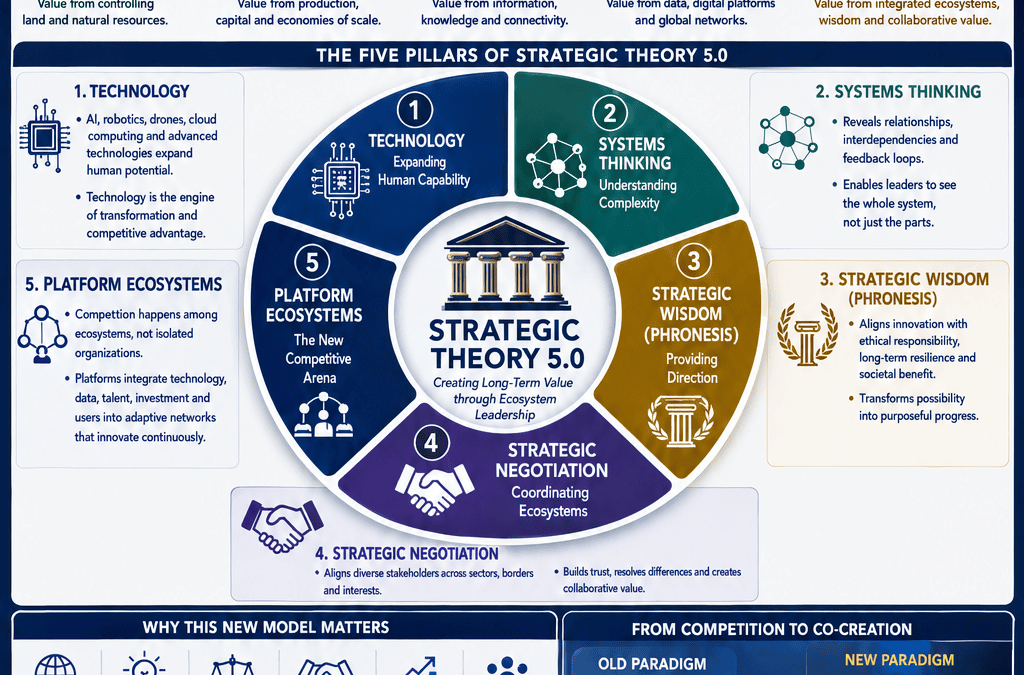
The accelerating Human–Technology Revolution requires an evolution in strategic thought. Traditional strategy emphasized competition among firms and the optimization of resources. Strategic Theory 5.0 proposes that sustainable competitive advantage increasingly depends upon the integration of technological capability, Systems Thinking, Strategic Wisdom, Strategic Negotiation, and Platform Ecosystems into a unified model of ecosystem leadership. The Techne–Phronesis Negotiation Framework™ provides one conceptual architecture for understanding this transition.
Abstract
The accelerating convergence of Artificial Intelligence, robotics, drones, Geospatial Intelligence (GEOINT), digital platforms, cloud computing, and advanced communications is reshaping the foundations of strategy. Models developed during the Industrial and Information Ages remain valuable, yet they require expansion to address the complexity of technological civilization. This essay proposes Strategic Theory 5.0 as a conceptual evolution in strategic thought. Rather than replacing earlier theories, Strategic Theory 5.0 integrates technological capability, Systems Thinking, Strategic Wisdom, Strategic Negotiation, and Platform Ecosystems into a comprehensive framework for leading innovation, governing complexity, and creating long-term value. The Techne–Phronesis Negotiation Framework™ provides the intellectual architecture supporting this perspective.
Introduction
Every era develops strategic principles that reflect its dominant economic and technological realities.
Agrarian societies emphasized land and agricultural productivity.
Industrial societies emphasized factories, capital, and economies of scale.
The Information Age elevated knowledge, globalization, and digital communication.
Today, technological civilization demands a broader strategic perspective capable of integrating technological innovation with human judgment, ecosystem governance, and collaborative leadership.
This transition marks the emergence of what may be described as Strategic Theory 5.0.
Why Traditional Strategy Must Evolve
Classical strategic management focused primarily on organizations competing within industries.
Technological civilization has fundamentally changed this environment.
Organizations increasingly operate within interconnected ecosystems where innovation emerges through collaboration among technology firms, universities, governments, investors, research institutions, startups, and users.
Competitive advantage is therefore becoming increasingly systemic rather than organizational.
Strategy must evolve accordingly.
The Five Pillars of Strategic Theory 5.0
1. Technology: Expanding Human Capability
Technology is the engine of transformation in technological civilization.
Artificial Intelligence, robotics, drones, cloud computing, autonomous systems, advanced communications, and digital platforms continuously expand human capability and redefine competitive possibilities.
Technology enables organizations to innovate faster, collaborate globally, and create entirely new industries. However, technological capability alone does not guarantee strategic success. It must be integrated into a broader system of leadership and governance.
2. Systems Thinking: Understanding Complexity
Technological ecosystems operate as complex adaptive systems rather than isolated organizations.
Systems Thinking enables leaders to recognize relationships, feedback loops, interdependencies, resilience, and emerging opportunities across governments, industries, universities, research institutions, investors, and society.
Without systemic understanding, technological capability cannot be coordinated effectively or transformed into sustainable competitive advantage.
3. Strategic Wisdom (Phronesis): Providing Direction
Ancient Greek philosophy teaches that capability without judgment is insufficient.
Strategic Wisdom (Phronesis) aligns technological innovation with ethical responsibility, long-term resilience, societal benefit, and sustainable development.
Wisdom transforms technological possibility into purposeful progress by ensuring that innovation serves humanity rather than becoming an objective in itself.
4. Strategic Negotiation: Coordinating Ecosystems
Modern technological ecosystems require continuous coordination among diverse stakeholders.
Strategic Negotiation enables governments, industries, universities, investors, technology companies, and international partners to build trust, align strategic objectives, resolve competing interests, and create collaborative value.
Negotiation therefore becomes an instrument of ecosystem governance rather than merely a mechanism for resolving conflict.
5. Platform Ecosystems: The New Competitive Arena
Competitive advantage increasingly emerges from interconnected platform ecosystems rather than isolated organizations.
Platform ecosystems integrate technology, data, talent, investment, knowledge, and users into adaptive networks capable of continuous innovation and long-term resilience.
Leadership therefore evolves from managing individual organizations to orchestrating entire ecosystems that create shared value through collaboration, learning, and innovation.
The Techne–Phronesis Negotiation Framework™
The Techne–Phronesis Negotiation Framework™ integrates these five pillars into a coherent model of strategic leadership.
Techne generates capability.
Systems Thinking creates understanding.
Phronesis provides strategic direction.
Strategic Negotiation aligns stakeholders.
Platform Ecosystems become the environment in which innovation, resilience, and sustainable value are created.
Together, these dimensions offer a conceptual foundation for Strategic Theory 5.0.
Implications for Leadership
Leaders operating within technological civilization must increasingly function as ecosystem architects.
Their responsibilities extend beyond organizational management to include:
- integrating emerging technologies,
- fostering interdisciplinary collaboration,
- strengthening institutional trust,
- developing resilient innovation ecosystems,
- creating long-term societal value.
Strategic success depends upon balancing technological excellence with human judgment and collaborative governance.
The Human–Technology Revolution is transforming the nature of strategy itself.
Traditional strategic models remain valuable, but they require expansion to address the realities of technological ecosystems, digital platforms, Artificial Intelligence, and global innovation networks.
Strategic Theory 5.0 proposes that sustainable competitive advantage increasingly depends upon five interconnected pillars:
- Technology,
- Systems Thinking,
- Strategic Wisdom,
- Strategic Negotiation,
- Platform Ecosystems.
The Techne–Phronesis Negotiation Framework™ provides an integrated conceptual architecture through which these pillars can be understood and applied.
Technology creates capability.
Systems Thinking creates understanding.
Strategic Wisdom creates direction.
Strategic Negotiation creates alignment.
Platform Ecosystems create resilience and continuous innovation.
Together, they form a strategic perspective capable of guiding leadership within technological civilization and creating enduring value for future generations
Source: Open Sources Analysis, Relative Data Analysis by Nikos Chatzis
© Nikolaos Chatzis. The Techne–Phronesis Negotiation Framework™
Technology Creates Capability • Systems Thinking Creates Understanding • Strategic Wisdom Creates Lasting Value.
Negotiation.gr | Strategic Wisdom for the Technological Age