Negotiation.gr | Strategic Wisdom for the Technological Age
Abstract
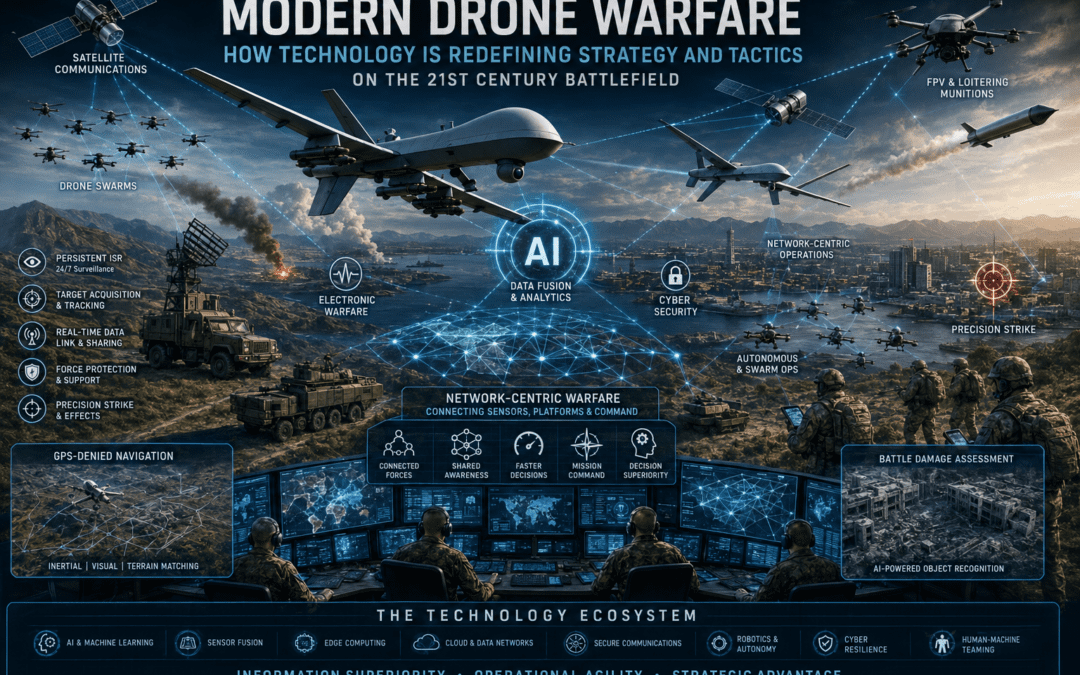
The emergence of unmanned aerial systems has fundamentally transformed modern warfare. Once viewed primarily as reconnaissance platforms, drones now perform intelligence collection, precision strike, electronic warfare, logistics, communication relay, target acquisition, battle damage assessment, and autonomous missions. However, the true revolution extends beyond the aircraft itself. Modern drone warfare represents the convergence of Artificial Intelligence, geospatial intelligence, satellite communications, cybersecurity, autonomous systems, cloud computing, electronic warfare, and network-centric operations into integrated technology ecosystems. This essay argues that contemporary battlefields are increasingly shaped by interconnected technological networks in which drones serve as intelligent nodes within broader ecosystems of information superiority, rapid decision-making, and multidomain operations.
Introduction
Military history has repeatedly demonstrated that technological innovation reshapes strategy.
Gunpowder transformed medieval warfare.
The steam engine transformed logistics.
Aircraft transformed operational reach.
Radar transformed air defense.
Computers transformed command and control.
Today, unmanned aerial systems are transforming warfare once again.
Yet the real revolution lies not simply in drones.
It lies in the technological ecosystems supporting them.
From Platform to Ecosystem
Early military drones functioned primarily as surveillance platforms.
Today’s systems perform multiple interconnected missions.
Modern drone operations integrate:
- Artificial Intelligence,
- satellite navigation,
- secure communications,
- cloud computing,
- geospatial intelligence,
- electronic warfare,
- cybersecurity,
- precision navigation,
- digital mapping.
The aircraft itself becomes one intelligent component within a much larger operational ecosystem.
Artificial Intelligence
Artificial Intelligence increasingly functions as the cognitive layer of modern drone warfare.
AI enables:
- object recognition,
- autonomous navigation,
- target identification,
- sensor fusion,
- route optimization,
- predictive maintenance,
- swarm coordination,
- decision support.
Rather than replacing commanders, AI accelerates the speed at which information becomes actionable intelligence.
Human judgment remains central to decisions about the use of force.
Geospatial Intelligence
Every drone mission generates information.
Electro-optical imagery.
Infrared imagery.
Synthetic aperture radar.
Terrain models.
Three-dimensional mapping.
Signals intelligence.
Geospatial intelligence transforms this data into operational knowledge.
Modern commanders increasingly understand the battlefield before forces arrive.
Information superiority becomes strategic superiority.
Network-Centric Warfare
The modern battlefield is increasingly network-centric.
Sensors detect.
Drones observe.
Satellites communicate.
Artificial Intelligence analyzes.
Command centers coordinate.
Ground forces maneuver.
Every platform contributes to a shared operational picture.
Decision cycles become significantly shorter.
This integration improves situational awareness while increasing operational agility.
Electronic Warfare
Modern drone warfare increasingly includes competition within the electromagnetic spectrum.
Electronic warfare includes:
- GPS interference,
- communications jamming,
- spectrum management,
- electronic protection,
- electronic support.
As drones become more capable, protecting communications and navigation systems becomes increasingly important.
Electronic resilience therefore becomes a key operational requirement.
Autonomous Systems
Autonomy is expanding rapidly.
Future drones will increasingly perform:
- collaborative missions,
- swarm operations,
- autonomous navigation,
- dynamic route adaptation,
- distributed sensing.
These developments have the potential to increase operational flexibility while also raising important questions about human oversight, accountability, and command responsibility.
FPV and Low-Cost Systems
Recent conflicts have demonstrated that relatively inexpensive first-person-view drones can affect tactical operations when combined with training, intelligence, and rapid adaptation.
Their impact illustrates that effectiveness is not determined solely by platform cost but also by doctrine, innovation, logistics, and operational integration.
This represents a broader lesson: adaptable systems can sometimes offset numerical or technological disadvantages.
Human–Machine Teaming
The future battlefield is likely to be characterized by cooperation between humans and intelligent systems.
Commanders will increasingly direct networks of autonomous platforms.
Artificial Intelligence will support analysis.
Humans will provide strategic judgment.
This partnership combines computational speed with contextual understanding and ethical responsibility.
The Technology Ecosystem of Drone Warfare
Modern drone warfare integrates:
- aerospace engineering,
- Artificial Intelligence,
- geospatial intelligence,
- cloud computing,
- satellite communications,
- cybersecurity,
- software engineering,
- robotics,
- electronic warfare,
- logistics,
- military doctrine.
No single technology explains battlefield effectiveness.
Success increasingly depends upon the resilience and integration of the entire ecosystem.
Strategic and Tactical Transformation
Drone ecosystems influence operations at multiple levels.
At the tactical level they enhance reconnaissance, target acquisition, force protection, and precision engagement.
At the operational level they improve command, coordination, logistics, and multidomain synchronization.
At the strategic level they influence deterrence, defense planning, industrial capacity, technological competition, and alliance interoperability.
Technology therefore shapes not only tactics but also the broader strategic environment.
The Human Dimension
Technology does not eliminate the importance of leadership.
Effective drone operations still depend upon:
- professional education,
- disciplined operators,
- strategic planning,
- legal compliance,
- ethical judgment,
- adaptive leadership.
Technology amplifies human capability.
It does not replace strategic wisdom.
Looking Toward the Future
The future battlefield will likely include:
- autonomous drone swarms,
- AI-assisted mission planning,
- resilient satellite communications,
- quantum-resistant cybersecurity,
- edge computing,
- digital twins,
- integrated multidomain operations.
The decisive advantage will increasingly belong to those capable of connecting these capabilities into coherent, resilient technology ecosystems.
Modern drone warfare represents far more than the introduction of a new class of military platforms. It reflects a broader transformation in the conduct of military operations, where Artificial Intelligence, geospatial intelligence, autonomous systems, network-centric warfare, cybersecurity, and digital infrastructure combine to create integrated technology ecosystems.
Within these ecosystems, drones function as intelligent nodes rather than isolated weapons systems. Their effectiveness depends upon information flows, resilient communications, human expertise, innovation, and strategic coordination.
The future battlefield will therefore be shaped less by individual technologies than by the quality of the ecosystems that connect them. Strategic advantage will increasingly belong to armed forces capable of integrating technology, doctrine, industry, education, and leadership into adaptive networks of continuous innovation.
In the twenty-first century, modern warfare is becoming the competition of interconnected defense technology ecosystems, and drones are among their most visible and transformative expressions.
Source: Open Sources Analysis, Relative Data Analysis by Nikos Chatzis
© 2026 Nikolaos Chatzis – negotiation.gr. All Rights Reserved. No part of this publication may be reproduced, distributed, or transmitted without prior written permission, except for brief quotations with proper attribution.
Negotiation.gr | Strategic Wisdom for the Technological Age