Negotiation.gr | Strategic Wisdom for the Technological Age
Abstract
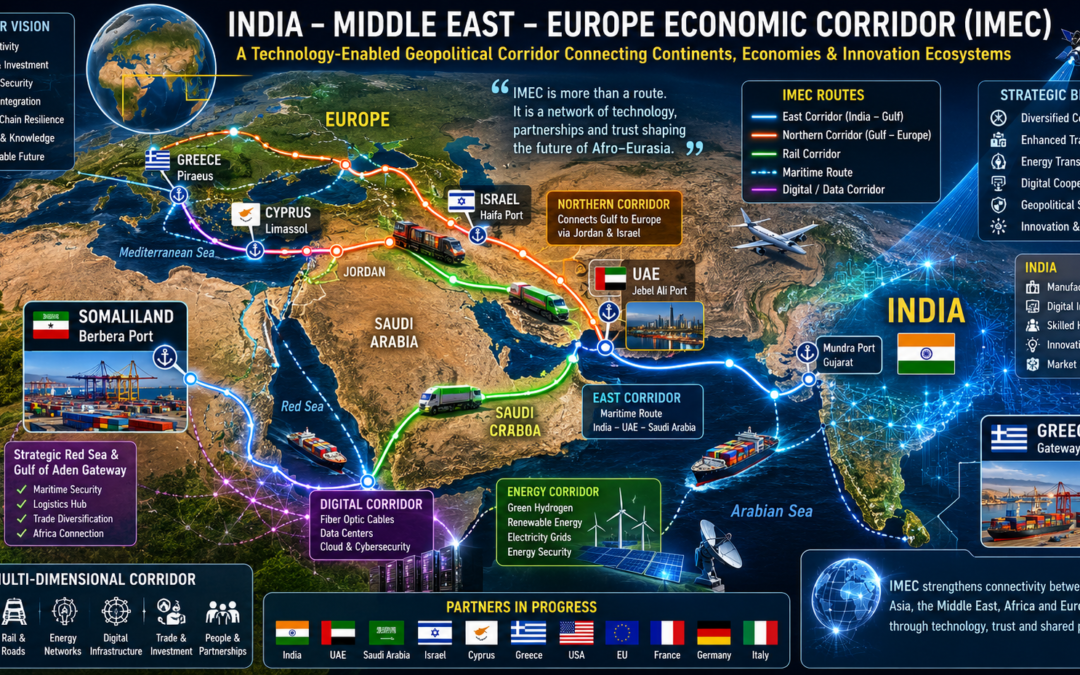
The India-Middle East-Europe Economic Corridor represents one of the most ambitious connectivity projects of the twenty-first century. Although it is often described as a trade and transport corridor, its deeper significance lies in the convergence of technology, geopolitics, logistics, energy, digital infrastructure, maritime security, and strategic partnerships. This thesis argues that IMEC should be understood not merely as a route connecting India to Europe, but as a technology-enabled geopolitical ecosystem linking the Indo-Pacific, the Gulf, the Red Sea, the Eastern Mediterranean, and Europe. Through India, the UAE, Somaliland, Israel, Cyprus, and Greece, the corridor reflects a new model of geopolitical connectivity in which ports, data cables, energy networks, smart logistics, defense cooperation, and technology diplomacy become instruments of regional influence and strategic transformation.
Introduction
Geopolitics has traditionally been defined by geography, military power, natural resources, and control of maritime routes. In the twenty-first century, however, technology has become a decisive layer of geopolitical influence. Corridors are no longer only roads, railways, and ports. They are integrated systems of digital infrastructure, energy transmission, logistics platforms, data flows, cybersecurity, financial networks, smart ports, and strategic partnerships.
The India-Middle East-Europe Economic Corridor, known as IMEC, is a clear example of this transformation. It was announced as a connectivity initiative linking India, the Middle East, and Europe through transport, energy, and digital infrastructure. Yet its strategic importance is much broader. It represents an attempt to reorganize economic geography through technological connectivity.
IMEC as a Technology-Enabled Geopolitical Corridor
IMEC should be understood as a multidimensional corridor composed of three interdependent layers.
The first layer is physical connectivity: ports, railways, logistics hubs, shipping routes, and intermodal transport systems.
The second layer is energy connectivity: electricity grids, renewable energy integration, green hydrogen corridors, and energy-market interconnection.
The third layer is digital connectivity: fiber-optic cables, data centers, cybersecurity systems, smart customs platforms, digital trade systems, and information exchange networks.
Together, these layers transform IMEC from a transport project into a technology ecosystem.
The corridor is therefore not only about moving goods faster. It is about building the infrastructure of strategic interdependence.
India: From Continental Power to Connectivity Power
India occupies the eastern anchor of IMEC.
For India, the corridor supports several strategic objectives.
First, it strengthens India’s access to European markets.
Second, it reduces overdependence on traditional maritime chokepoints.
Third, it supports India’s ambition to become a major manufacturing, digital, and logistics hub.
Fourth, it reinforces India’s role as a balancing power in the evolving global order.
Technology plays a central role in this vision. India’s strengths in digital public infrastructure, software, space technology, maritime awareness, and emerging industrial capacity can be integrated into a broader corridor strategy.
IMEC therefore allows India to project influence westward through technology, logistics, trade, and diplomacy.
The UAE: The Corridor’s Strategic Logistics Engine
The United Arab Emirates is one of the most important operational actors in the corridor.
The UAE possesses world-class ports, logistics companies, aviation networks, free zones, financial infrastructure, and global investment capacity.
Through companies such as DP World, Abu Dhabi and Dubai have developed extensive port and logistics networks across Asia, Africa, Europe, and the Middle East.
The UAE’s role is not simply geographic. It is infrastructural.
It can provide:
- port management,
- logistics execution,
- investment capital,
- digital trade platforms,
- maritime connectivity,
- supply chain coordination.
In this sense, the UAE functions as the corridor’s strategic logistics engine.
Its ability to connect the Indian Ocean, the Gulf, the Red Sea, and the Mediterranean gives it significant geopolitical leverage.
Somaliland and Berbera: The Red Sea-Horn of Africa Dimension
Although Somaliland is not part of the formal IMEC architecture, its geographic location and the development of Berbera Port make it strategically relevant to any broader Indo-Middle Eastern-European connectivity framework.
Berbera sits near the Gulf of Aden, one of the most important maritime zones linking the Indian Ocean to the Red Sea and the Mediterranean.
DP World’s investment in Berbera has transformed the port into a significant logistics asset. Reuters reported in 2026 that DP World emphasized its Berbera operations were continuing under existing agreements despite regional diplomatic tensions, while also noting the UAE’s $442 million investment in the port.
From a geopolitical perspective, Somaliland represents a potential southern hinge in wider corridor thinking.
Its importance lies in:
- Red Sea security,
- Gulf of Aden access,
- logistics diversification,
- maritime surveillance,
- port competition,
- Horn of Africa connectivity.
The inclusion of Somaliland in broader strategic analysis is therefore not about formal recognition alone. It is about maritime geography, port infrastructure, and corridor resilience.
Israel: The Eastern Mediterranean Technology Node
Israel occupies a critical position between the Gulf and the Mediterranean.
Within IMEC, Israel’s importance is not limited to geography. It is also technological.
Israel brings strengths in:
- cybersecurity,
- defense technology,
- ports,
- logistics,
- artificial intelligence,
- water technology,
- innovation ecosystems,
- startup culture.
Its Mediterranean ports can serve as gateways between the Middle East and Europe.
However, Israel’s role also introduces political complexity. Regional instability, the Palestinian issue, and tensions with Iran and its allies can affect the corridor’s viability.
This means Israel is both a strategic asset and a geopolitical risk factor.
From a technological perspective, Israel could become one of the corridor’s most important innovation nodes.
From a political perspective, its integration depends on broader regional normalization and security conditions.
Cyprus: The Maritime and Digital Gateway to Europe
Cyprus has increasingly presented itself as a potential gateway between India, the Middle East, and Europe.
Its location in the Eastern Mediterranean, its EU membership, and its maritime capabilities make it relevant to IMEC’s European extension.
Recent India-Cyprus discussions have emphasized defense, maritime, and cybersecurity cooperation, with Indian Prime Minister Narendra Modi identifying Cyprus as a crucial link for IMEC due to its geography and EU status.
Cyprus can contribute to the corridor through:
- shipping services,
- maritime security,
- cybersecurity cooperation,
- digital connectivity,
- financial services,
- energy infrastructure,
- Eastern Mediterranean diplomacy.
It may not replace larger ports in Greece, Italy, or France, but it can serve as a strategic platform for maritime coordination and digital connectivity.
Cyprus is especially important because it connects three worlds: the Middle East, the European Union, and the Eastern Mediterranean.
Greece: The Southeastern European Gateway
Greece is the natural European gateway for the eastern Mediterranean dimension of IMEC.
Its ports, especially Piraeus and potentially other Greek logistics nodes, give it a strategic position in connecting the Eastern Mediterranean to the Balkans, Central Europe, and the wider European market.
Greece’s significance lies in:
- maritime access,
- EU membership,
- Balkan connectivity,
- energy infrastructure,
- logistics corridors,
- shipping expertise,
- Eastern Mediterranean diplomacy.
For Greece, IMEC could strengthen its position as a logistics, energy, and technology bridge between Europe, the Middle East, and India.
The corridor also creates opportunities for Greek participation in digital infrastructure, smart ports, cybersecurity, maritime surveillance, drone-based monitoring, and geospatial intelligence.
Technology as the Corridor’s Hidden Architecture
The true strategic importance of IMEC lies in its technological architecture.
The corridor depends on:
- smart ports,
- customs digitization,
- railway logistics platforms,
- satellite navigation,
- cybersecurity,
- maritime domain awareness,
- renewable energy systems,
- green hydrogen infrastructure,
- subsea data cables,
- cloud services,
- supply chain monitoring.
These technologies convert geography into strategic capability.
Without technology, IMEC is only a route.
With technology, it becomes an integrated geopolitical ecosystem.
IMEC and the Belt and Road Initiative
IMEC is often interpreted as a partial alternative to China’s Belt and Road Initiative.
This comparison is understandable but incomplete.
The Belt and Road Initiative focuses heavily on infrastructure finance, physical connectivity, and Chinese strategic influence.
IMEC reflects a different model:
- partnership-based connectivity,
- digital and energy integration,
- supply chain resilience,
- democratic and market-based coordination,
- strategic diversification.
The European Council on Foreign Relations has argued that IMEC can help the US and EU draw India closer while offering India a path to reduce strategic vulnerability and giving Gulf states a role as bridges between East and West.
Therefore, IMEC is not only a corridor. It is a geopolitical response to the changing structure of globalization.
Risks and Challenges
Despite its promise, IMEC faces major challenges.
These include:
- instability in the Middle East,
- Red Sea insecurity,
- Gaza war consequences,
- Iran-related tensions,
- Turkish opposition,
- Egyptian concerns over Suez Canal relevance,
- financing complexity,
- governance fragmentation,
- lack of operational clarity,
- competing corridor projects.
Le Monde reported that the project has faced disruption from Middle Eastern instability, the Gaza war, political changes in Washington, and opposition from countries such as Egypt and Turkey.
The corridor’s success therefore depends not only on infrastructure investment but also on political stabilization, diplomatic coordination, and strategic negotiation.
The Role of Technology Diplomacy
Technology diplomacy will be essential for IMEC.
The corridor requires coordination among states, ports, private companies, technology providers, regulators, investors, defense institutions, and international organizations.
Technology diplomacy can help align:
- digital standards,
- cybersecurity protocols,
- logistics platforms,
- energy cooperation,
- maritime security,
- data governance,
- customs modernization,
- infrastructure investment.
This is where strategic negotiation becomes critical.
IMEC will succeed only if its participants can build trust, align incentives, manage geopolitical risks, and create shared value.
The India-Middle East-Europe Economic Corridor represents more than a trade route. It is an emerging geopolitical technology ecosystem.
Its importance lies in the integration of ports, logistics, digital infrastructure, energy systems, maritime security, smart connectivity, and strategic partnerships.
India provides scale and strategic ambition.
The UAE provides logistics capacity and capital.
Somaliland’s Berbera Port highlights the importance of the Horn of Africa and Red Sea dimension.
Israel offers technological depth and Eastern Mediterranean access.
Cyprus provides an EU-linked maritime and cybersecurity gateway.
Greece offers the natural southeastern European bridge into the continent.
Together, these nodes illustrate a new reality: the future of geopolitics will increasingly be shaped by technology-enabled corridors.
IMEC’s success will depend not only on geography but on governance, technology diplomacy, strategic negotiation, digital integration, energy connectivity, and resilient partnerships.
In the twenty-first century, corridors are no longer simply lines on a map. They are technological ecosystems of power, influence, trade, energy, data, and strategic cooperation.
Source: Open Sources Analysis, Relative Data Analysis by Nikos Chatzis
© Nikolaos Chatzis. The Techne–Phronesis Negotiation Framework™
Technology Creates Capability • Systems Thinking Creates Understanding • Strategic Wisdom Creates Lasting Value.
Negotiation.gr | Strategic Wisdom for the Technological Age