Abstract
Technological innovation has become one of the defining forces shaping the international system of the twenty-first century. Unlike previous industrial revolutions, where technological progress primarily influenced economic productivity, today’s emerging technologies increasingly determine geopolitical influence, military capability, economic resilience, diplomatic leverage, and international governance. Artificial Intelligence, semiconductors, quantum computing, cybersecurity, autonomous systems, biotechnology, space technologies, and digital infrastructure are rapidly becoming instruments of national power.
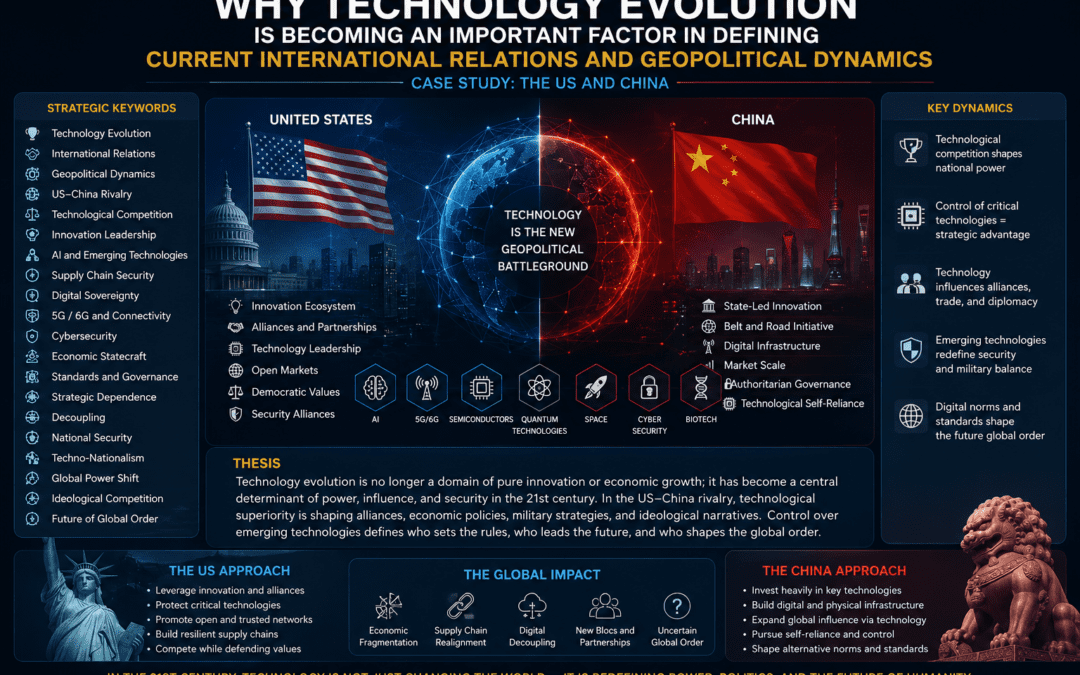
This thesis argues that technology evolution has fundamentally transformed the nature of international relations. The strategic competition between the United States and China demonstrates that technological leadership is no longer merely an economic objective but a central element of geopolitical strategy. As nations compete to establish technological superiority, the future international order will increasingly depend upon innovation ecosystems, technology diplomacy, strategic negotiation, and global technological governance.
Introduction
International relations have traditionally been shaped by geography, military capability, natural resources, economic power, and political alliances.
Today, however, technology has emerged as a sixth pillar of national power.
The ability to innovate, commercialize, regulate, and deploy advanced technologies increasingly determines the global influence of states.
Artificial Intelligence, semiconductor manufacturing, quantum computing, digital infrastructure, geospatial intelligence, autonomous systems, and cybersecurity are transforming the foundations of international competition.
Technology has become the new geopolitical currency.
The strategic rivalry between the United States and China provides perhaps the clearest example of this historic transformation.
Technology as National Power
Historically, technological innovation supported national development.
Today it defines national competitiveness.
Technological leadership influences:
- Economic growth
- Military modernization
- Industrial competitiveness
- Cyber resilience
- Intelligence capabilities
- Diplomatic influence
- Global standards
- Supply chain resilience
Countries capable of leading technological innovation increasingly shape international norms and institutions.
Technology has become a strategic asset comparable to energy resources during the twentieth century.
The United States and China: Competing Models
The strategic competition between the United States and China represents far more than a trade dispute.
It reflects competing visions regarding:
- technological leadership,
- innovation ecosystems,
- digital governance,
- industrial policy,
- international influence.
The United States traditionally emphasizes:
- entrepreneurial innovation,
- venture capital,
- university research,
- private-sector leadership,
- global alliances,
- open innovation.
China combines:
- long-term industrial planning,
- state-supported innovation,
- manufacturing scale,
- digital infrastructure,
- strategic investment,
- technological self-reliance.
Both models seek technological leadership, but they pursue different institutional pathways.
Emerging Technologies as Strategic Assets
The technologies shaping geopolitical competition include:
Artificial Intelligence
AI is transforming:
- economic productivity,
- defense,
- healthcare,
- logistics,
- intelligence analysis.
Semiconductors
Microchips represent the foundation of the digital economy.
Control over semiconductor production increasingly determines technological independence.
Quantum Computing
Quantum technologies promise revolutionary advances in:
- encryption,
- computing,
- scientific research,
- defense.
Cybersecurity
Digital resilience has become a national security priority.
Cyber capabilities increasingly influence diplomacy and conflict.
Space Technologies
Satellites support:
- communications,
- navigation,
- intelligence,
- climate monitoring,
- defense.
Autonomous Systems
Drones, robotics, and autonomous vehicles increasingly reshape both civilian industries and military operations.
Innovation Ecosystems
Technological leadership no longer depends upon isolated companies.
It depends upon innovation ecosystems integrating:
- governments,
- universities,
- research laboratories,
- startups,
- investors,
- global corporations,
- regulatory institutions.
These ecosystems accelerate knowledge creation, commercialization, and international competitiveness.
Innovation has become a national strategic capability.
Technology Diplomacy
Technology increasingly influences diplomacy itself.
Technology diplomacy seeks to:
- facilitate international cooperation,
- establish global standards,
- promote responsible innovation,
- strengthen strategic partnerships,
- manage technological competition.
Future diplomacy will increasingly involve negotiations over:
- Artificial Intelligence governance,
- cybersecurity,
- digital infrastructure,
- semiconductor supply chains,
- autonomous systems,
- space governance.
Technology diplomats will become central actors within international relations.
The Emerging Drone Ecosystem
The drone industry illustrates how technology has become geopolitical.
Modern UAV ecosystems combine:
- Artificial Intelligence,
- geospatial intelligence,
- cloud computing,
- telecommunications,
- satellite navigation,
- cybersecurity,
- defense technologies.
Drone technology now influences:
- food security,
- environmental monitoring,
- disaster response,
- border security,
- military operations,
- infrastructure management.
The future drone economy therefore represents a strategic intersection between technological innovation and geopolitical competition.
Strategic Negotiation in the Technology Era
As technologies become increasingly interconnected, strategic negotiation acquires new importance.
Governments, companies, universities, and international organizations must negotiate:
- technology standards,
- research partnerships,
- intellectual property,
- investment,
- supply chains,
- regulatory frameworks.
The ability to build innovation ecosystems increasingly depends upon ecosystem negotiation rather than transactional negotiation.
The Technology Ecosystem 3D Negotiator emerges as a professional capable of connecting stakeholders across technological, political, and international boundaries.
Looking Toward 2035
The next decade is likely to witness competition in:
- Artificial Intelligence
- Quantum Computing
- Space Technologies
- Biotechnology
- Semiconductors
- Autonomous Systems
- Geospatial Intelligence
- Advanced Communications
Countries capable of combining technological innovation with international partnerships and effective governance will possess significant strategic advantages.
Power will increasingly derive not only from military strength but also from technological ecosystems.
Technology evolution has fundamentally altered the structure of international relations. Emerging technologies now shape economic competitiveness, military capability, diplomatic influence, and geopolitical power. The strategic competition between the United States and China demonstrates that technological leadership is becoming one of the defining characteristics of the twenty-first-century international system.
The future global order will be determined not solely by territorial control or economic output but by the ability to build resilient innovation ecosystems, attract human talent, establish international partnerships, and govern emerging technologies responsibly.
In this environment, technology becomes more than an instrument of national development—it becomes the architecture of geopolitical influence. Understanding this transformation is essential for governments, businesses, researchers, and future leaders seeking to navigate the evolving landscape of global affairs.
Source: Open Sources Analysis, Relative Data Analysis by Nikos Chatzis
© 2026 Nikolaos Chatzis – negotiation.gr. All Rights Reserved. No part of this publication may be reproduced, distributed, or transmitted without prior written permission, except for brief quotations with proper attribution.