Abstract
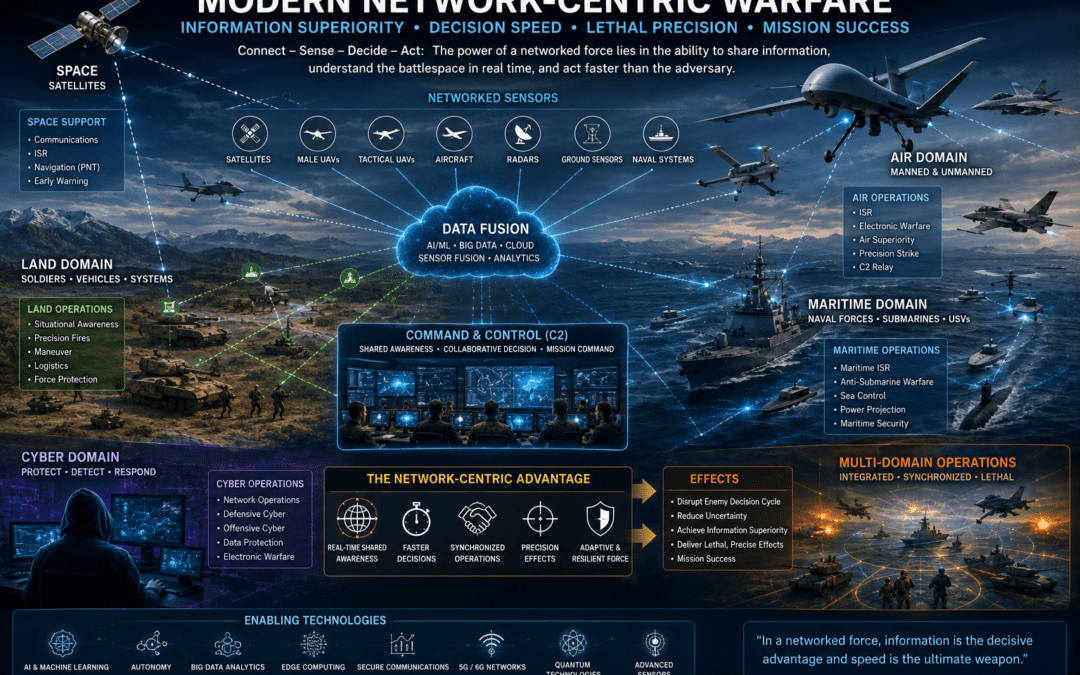
Modern warfare is undergoing a profound transformation driven by unmanned aerial systems, small tactical drones, loitering munitions, FPV drones, and Medium Altitude Long Endurance unmanned aerial vehicles. These systems are not merely new weapons platforms; they are central nodes in network-centric warfare. By connecting sensors, operators, command structures, artificial intelligence, geospatial intelligence, and precision-strike systems, drones are reshaping how militaries see, decide, coordinate, and act. This thesis argues that the revolutionary impact of drones lies not only in their ability to fly or strike, but in their ability to compress the decision cycle, expand battlefield transparency, distribute intelligence, and integrate military operations into a real-time digital combat network.
Introduction
Network-centric warfare is based on the idea that military effectiveness increases when forces are digitally connected through shared information, rapid communication, and coordinated action. In earlier eras, command depended heavily on hierarchical reporting, delayed reconnaissance, and centralized decision-making. Today, drones are transforming this model by providing persistent surveillance, real-time targeting, rapid battle damage assessment, and direct links between front-line units and command systems.
The modern battlefield is increasingly defined by sensors, data, connectivity, and speed. Drones have become one of the most important technologies in this environment because they extend the eyes, ears, and reach of military forces at relatively low cost.
From Platform Warfare to Network Warfare
Traditional military power was often measured by large platforms: tanks, aircraft, ships, artillery systems, and missile batteries. These platforms remain important, but their effectiveness now depends increasingly on the quality of the network around them.
Drones accelerate the transition from platform-centric warfare to network-centric warfare because they operate as mobile sensors, communication relays, target identifiers, electronic warfare tools, and strike platforms.
Their value lies in their integration with:
- Command and control systems
- Intelligence, surveillance, and reconnaissance networks
- Artillery and missile systems
- Electronic warfare units
- Geospatial intelligence platforms
- Artificial intelligence tools
- Ground maneuver forces
The drone is therefore not only an aircraft. It is a node in a combat information ecosystem.
The Role of ISR Drones
Intelligence, Surveillance, and Reconnaissance drones have become essential to modern operations. They provide commanders with continuous visibility over enemy movements, terrain, logistics, fortifications, and battlefield changes.
ISR drones enhance network-centric warfare by enabling:
- Persistent surveillance
- Real-time target detection
- Artillery correction
- Route monitoring
- Force protection
- Battle damage assessment
This creates what many analysts call battlefield transparency. Forces can hide less easily when small drones, tactical UAVs, MALE platforms, satellites, electronic sensors, and human intelligence are fused into a single operational picture.
MALE UAVs and Operational Depth
Medium Altitude Long Endurance UAVs occupy a different role from small tactical drones. While small drones dominate the immediate tactical battlefield, MALE UAVs provide endurance, range, payload capacity, and persistent operational-level surveillance.
MALE platforms are especially valuable for:
- Long-duration ISR missions
- Maritime surveillance
- Border security
- Signals intelligence
- Precision strike support
- Theater-wide monitoring
- Strategic deterrence
Their ability to remain airborne for long periods allows commanders to maintain situational awareness across large areas. This makes MALE UAVs important not only for tactical operations but also for operational and strategic decision-making.
Compressing the Kill Chain
One of the most important effects of drones is the compression of the kill chain.
The traditional sequence of warfare includes finding, fixing, tracking, targeting, engaging, and assessing. In older systems, this process could take hours or days. With drones integrated into digital command networks, the cycle can be dramatically shortened.
A drone may detect a target, transmit coordinates, guide artillery or precision munitions, observe the strike, and immediately assess the result.
This creates a faster and more adaptive battlefield.
The side that can observe, decide, and strike faster often gains a decisive advantage.
From Kill Chain to Kill Web
Modern warfare is moving beyond the linear kill chain toward the concept of the kill web.
In a kill web, multiple sensors, shooters, command nodes, and data platforms interact dynamically. A target detected by one drone may be engaged by artillery, missiles, another drone, aircraft, or ground forces.
This networked approach increases flexibility and resilience.
Drones are especially important because they can multiply the number of available sensors and connect tactical units to wider operational networks.
FPV Drones and Tactical Precision
First-person-view drones have transformed tactical warfare by providing low-cost precision strike capability.
Although individually small and inexpensive, FPV drones can threaten vehicles, trenches, radar systems, artillery positions, logistics nodes, and personnel.
Their importance lies in the combination of:
- Low cost
- High availability
- Tactical flexibility
- Operator control
- Precision attack
- Rapid adaptation
FPV drones democratize precision strike by giving small units capabilities that previously required expensive weapons systems.
Loitering Munitions
Loitering munitions occupy a middle ground between drones and missiles.
They can search for targets, remain airborne, and strike when an opportunity appears.
Their value in network-centric warfare comes from their ability to combine reconnaissance and strike into one system.
They are particularly useful against mobile targets, air defenses, artillery, radar systems, and command posts.
AI and Autonomous Systems
Artificial Intelligence is becoming increasingly important in drone warfare.
AI can support:
- Object recognition
- Navigation
- Target classification
- Sensor fusion
- Mission planning
- Swarm coordination
- Predictive analytics
The future battlefield will likely involve increasing levels of human-machine teaming. Humans will remain responsible for judgment, legality, and strategic decisions, while machines will increasingly assist with detection, classification, data processing, and operational speed.
AI does not replace the commander. It strengthens the network.
Electronic Warfare and Counter-UAS
The rise of drones has also increased the importance of electronic warfare.
Drone operations depend on communications, navigation, data links, and control systems. These dependencies create vulnerabilities.
Modern counter-UAS systems include:
- Jamming
- Spoofing
- Directed energy
- Kinetic interception
- Radar detection
- Acoustic detection
- Cyber disruption
- Hardening and redundancy
This creates a continuous technological competition between drone innovation and counter-drone adaptation.
The drone battlefield is therefore also an electromagnetic battlefield.
Swarm Drones and Distributed Warfare
Swarm drones represent one of the most disruptive future developments.
A swarm can overwhelm defenses, distribute sensing, confuse adversaries, and attack from multiple directions.
Swarming changes warfare because it favors distributed systems over centralized platforms.
Instead of relying on a few expensive assets, militaries may increasingly deploy many smaller, attritable, networked systems.
This changes the economics of war.
It also complicates defense planning because traditional air defenses were not designed to defeat large numbers of low-cost autonomous systems.
Strategic Effects
Drones create strategic effects in several ways.
First, they reduce the cost of surveillance and strike.
Second, they increase battlefield transparency.
Third, they make rear areas less safe.
Fourth, they force adversaries to disperse, conceal, and harden their forces.
Fifth, they accelerate innovation cycles.
Sixth, they increase the importance of domestic technology ecosystems.
Modern drone warfare is not only about military tactics. It is also about industrial capacity, software development, training, logistics, and rapid adaptation.
The Human Factor
Despite technological advances, humans remain central.
Effective drone warfare requires:
- Trained operators
- Tactical judgment
- Ethical decision-making
- Command discipline
- Intelligence analysis
- Maintenance teams
- Adaptation under pressure
The best drone force is not simply the one with the most drones. It is the force that integrates drones into doctrine, training, command structures, and operational culture.
Drones and MALE UAVs are revolutionizing network-centric warfare because they transform the relationship between information, decision-making, and military action. They extend situational awareness, compress the kill chain, support precision strike, enable distributed operations, and connect tactical units to broader command networks.
Small drones dominate the tactical edge. MALE UAVs provide endurance, reach, and operational depth. Loitering munitions merge surveillance and strike. AI-enabled systems accelerate data processing and decision support. Counter-UAS and electronic warfare define the struggle for control of the electromagnetic environment.
The result is a new form of warfare in which effectiveness depends less on individual platforms and more on the integration of sensors, data, networks, humans, and weapons into a coherent operational ecosystem.
In modern network-centric warfare, drones are not simply tools of observation or attack. They are the connective tissue of the digital battlefield.
Source: Open Sources Analysis, Relative Data Analysis by Nikos Chatzis
© 2026 Nikolaos Chatzis – negotiation.gr. All Rights Reserved. No part of this publication may be reproduced, distributed, or transmitted without prior written permission, except for brief quotations with proper attribution.