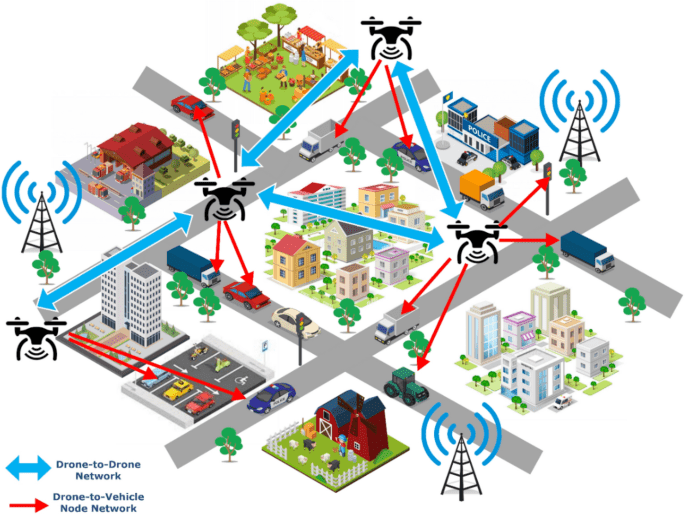
The rapid development of Unmanned Aircraft Systems (UAS) represents one of the most significant technological transformations in modern aviation. Drones are no longer merely flying platforms; they have evolved into integrated systems that combine aviation, artificial intelligence, geospatial intelligence, telecommunications, data analytics, remote sensing, and autonomous decision-making. As a result, the future of the drone industry will not be shaped solely by technological innovation but also by the ability of diverse stakeholders to cooperate across organizational, national, and disciplinary boundaries.
The companies that will lead this transformation are not necessarily those that possess the most advanced hardware. Rather, they will be those capable of building sustainable ecosystems of innovation, professional applications, research partnerships, and international collaboration. Organizations such as GeoSense represent this new generation of technology-driven enterprises, where professional UAV applications, geospatial technologies, training, research and development, and industry integration converge into a single operational framework.
The future of the drone industry lies in the creation of interconnected ecosystems. Drones are already transforming sectors such as precision agriculture, infrastructure inspection, environmental monitoring, emergency management, surveying, mapping, logistics, and security operations. However, each of these applications requires collaboration among regulators, technology providers, academic institutions, private companies, public authorities, and end users. The challenge is therefore not merely technological; it is organizational, political, and strategic.
This is where the principles of 3D Negotiations become increasingly relevant. Developed as a framework for creating value and managing complex stakeholder relationships, 3D Negotiations emphasizes the importance of shaping the environment in which agreements are made. Success depends not only on what happens at the negotiating table but also on the architecture of relationships, incentives, coalitions, and long-term partnerships that make cooperation possible.
The emerging drone ecosystem is, in essence, a global negotiation environment. Governments seek regulatory certainty and public safety. Industry seeks innovation and market growth. Academic institutions pursue research and knowledge creation. Communities demand transparency and trust. International organizations promote standards and interoperability. The successful integration of drone technologies requires the alignment of these diverse interests into mutually beneficial frameworks of cooperation.
The geopolitical dimension further reinforces this reality. Drones have become strategic assets in contemporary international affairs. Their applications extend beyond commercial uses into domains such as border security, disaster response, critical infrastructure protection, environmental resilience, and national security. Consequently, the evolution of drone technologies is increasingly influenced by geopolitical developments, regulatory competition, technological sovereignty concerns, and international standards-setting processes.
In such an environment, technical expertise alone is no longer sufficient. The drone sector increasingly requires professionals capable of understanding technology, policy, communication, negotiation, and international relations simultaneously. The ability to translate technical innovation into strategic partnerships and public value is becoming a critical success factor.
International journalism contributes another essential dimension to this process. Journalists operate at the intersection of information, communication, and public understanding. They learn to explain complex developments to diverse audiences, identify emerging trends, and understand how narratives influence decision-making. As drone technologies become more integrated into society, effective communication will be crucial in building public trust, fostering stakeholder engagement, and facilitating international dialogue.
The convergence of drone technology, geopolitics, international relations, and strategic communication creates a unique opportunity for a new generation of professionals. These individuals must be capable of bridging technical and non-technical communities, connecting innovation with policy, and transforming potential conflicts of interest into opportunities for cooperation.
In this context, the future of the drone industry is not merely a technological story. It is a story of human collaboration. It is a story about building relationships between innovators and regulators, between industry and academia, between local communities and global institutions. It is a story about creating frameworks through which technology can generate economic value, social benefit, and international cooperation.
The most successful drone ecosystems of the future will therefore be those that combine technological excellence with strategic vision, innovation with responsibility, and technical capability with the human skills of negotiation, diplomacy, and communication.
As drone technologies continue to evolve, the challenge before us is clear: not simply to develop more advanced systems, but to create the partnerships, institutions, and collaborative environments that allow these technologies to contribute positively to society. The future belongs to those who can build bridges between disciplines, sectors, and nations, transforming technological potential into sustainable cooperation and shared progress.
Source: Open Sources & Relative Data Valuation -Nikos Chatzis
© 2026 Nikolaos Chatzis – negotiation.gr. All Rights Reserved. No part of this publication may be reproduced, distributed, or transmitted without prior written permission, except for brief quotations with proper attribution.