Abstract
The accelerating pace of technological innovation is transforming the way organizations, governments, universities, and industries collaborate. Artificial Intelligence, geospatial intelligence, autonomous systems, digital platforms, biotechnology, and advanced communications increasingly develop within interconnected technology ecosystems rather than isolated organizations. As these ecosystems become more complex, effective governance emerges as a decisive factor influencing innovation, resilience, competitiveness, and long-term value creation.
This thesis argues that successful technology ecosystem governance depends upon integrating strategic thinking with disciplined everyday practice. Vision without execution remains theoretical, while operational excellence without strategic direction risks fragmentation. Sustainable innovation therefore requires governance frameworks capable of aligning stakeholders, fostering collaboration, managing risk, and translating long-term objectives into daily organizational behavior.
Introduction
Technology ecosystems have become the fundamental organizational model of the innovation economy.
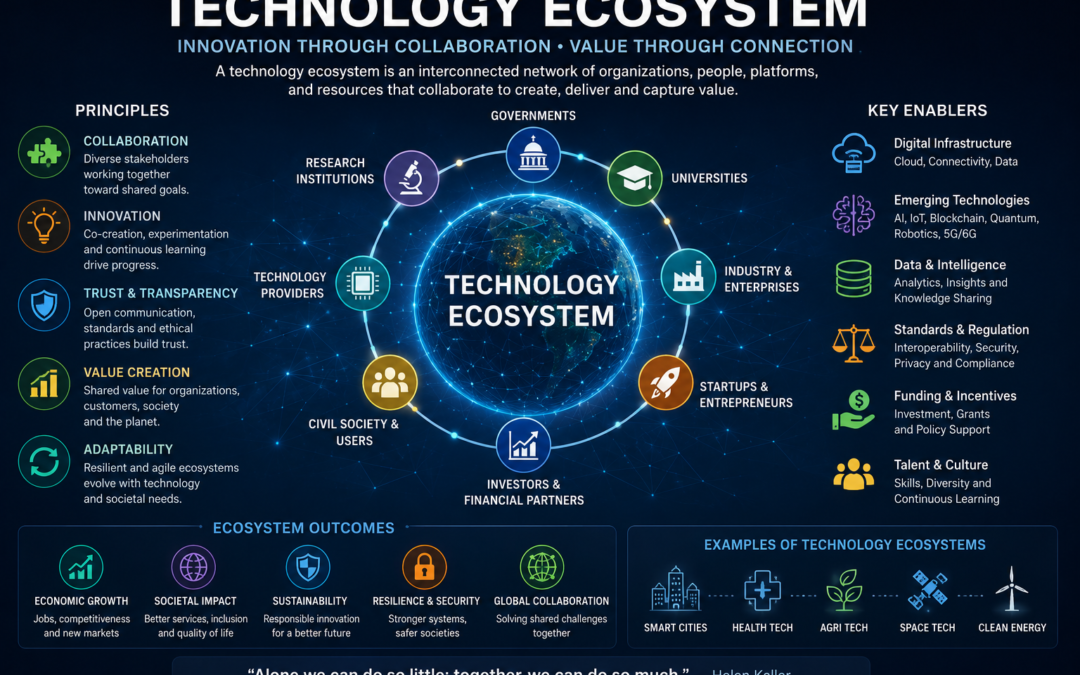
Unlike traditional industrial structures built around individual firms, technology ecosystems integrate universities, research institutions, governments, investors, technology companies, regulatory authorities, startups, and end users into collaborative networks that generate continuous innovation.
The challenge is no longer simply creating new technologies.
The challenge is governing the environments in which innovation occurs.
Technology ecosystem governance therefore becomes both a strategic capability and an operational discipline.
Defining Technology Ecosystem Governance
Technology ecosystem governance may be defined as:
The coordinated management of relationships, institutions, policies, resources, and collaborative processes that enable diverse stakeholders to generate sustainable technological innovation while creating economic, societal, and strategic value.
Governance extends beyond administration.
It provides the strategic architecture through which innovation ecosystems operate.
Strategic Thinking as the Foundation
Technology ecosystems require leaders capable of thinking beyond immediate operational challenges.
Strategic thinking involves:
- Systems thinking
- Long-term vision
- Future scenario planning
- Innovation forecasting
- Risk anticipation
- Opportunity identification
Strategic leaders continuously evaluate how emerging technologies, geopolitical developments, market dynamics, and regulatory changes influence ecosystem evolution.
They govern for the future rather than merely managing the present.
Everyday Practice: Strategy in Action
Strategic thinking achieves value only when translated into daily practice.
Everyday governance includes:
- Stakeholder communication
- Knowledge sharing
- Project coordination
- Cross-functional collaboration
- Continuous learning
- Performance monitoring
- Conflict resolution
- Resource allocation
These operational activities determine whether strategic objectives become organizational reality.
Successful ecosystems treat everyday interactions as opportunities to reinforce long-term strategic direction.
Principle One: Shared Vision
Innovation ecosystems require a clearly articulated purpose understood by all participants.
A shared vision aligns diverse organizations around common objectives while allowing individual participants to pursue specialized contributions.
Without strategic alignment, ecosystems fragment into disconnected initiatives.
Principle Two: Stakeholder Collaboration
No technology ecosystem succeeds through isolated excellence.
Governance must encourage collaboration among:
- Governments
- Universities
- Research laboratories
- Startups
- Investors
- Technology firms
- Civil society
Stakeholder diversity becomes an innovation advantage when supported by effective governance mechanisms.
Principle Three: Adaptive Leadership
Technology evolves continuously.
Governance must therefore remain flexible.
Adaptive leaders encourage experimentation, continuous improvement, and organizational learning while maintaining strategic coherence.
Adaptability becomes a competitive advantage within rapidly changing technological environments.
Principle Four: Trust and Transparency
Innovation depends upon trust.
Organizations share knowledge, resources, and expertise only when governance frameworks promote transparency, accountability, and ethical behavior.
Trust reduces collaboration costs while accelerating innovation.
Principle Five: Knowledge Integration
Technology ecosystems produce knowledge across multiple disciplines.
Governance must facilitate:
- interdisciplinary collaboration,
- knowledge transfer,
- organizational learning,
- research commercialization.
Knowledge integration transforms isolated expertise into collective intelligence.
Principle Six: Responsible Innovation
Emerging technologies create opportunities alongside ethical and societal challenges.
Governance therefore incorporates:
- ethical Artificial Intelligence,
- cybersecurity,
- privacy protection,
- sustainability,
- regulatory compliance,
- responsible innovation.
Technological progress must strengthen public trust rather than undermine it.
Principle Seven: Value Creation
Governance should continuously ask:
“How can this ecosystem create greater value for every participant?”
Value creation extends beyond financial performance.
Successful ecosystems generate:
- economic growth,
- scientific knowledge,
- societal benefit,
- environmental sustainability,
- international competitiveness,
- strategic resilience.
Technology Diplomacy and Global Governance
Technology ecosystems increasingly transcend national borders.
International collaboration requires governance mechanisms capable of supporting:
- research partnerships,
- technology transfer,
- global standards,
- digital infrastructure,
- innovation diplomacy.
Technology diplomacy therefore becomes an essential component of ecosystem governance.
The Role of Strategic Negotiation
Complex ecosystems inevitably involve competing interests.
Strategic negotiation enables stakeholders to:
- align objectives,
- resolve conflicts,
- build coalitions,
- design partnerships,
- expand collective value.
The principles of 3D Negotiation provide an effective framework for ecosystem governance because they emphasize relationship building, value creation, and strategic architecture rather than transactional bargaining.
Looking Toward the Future
As Artificial Intelligence, autonomous systems, quantum technologies, geospatial intelligence, biotechnology, and digital infrastructure continue to evolve, technology ecosystem governance will become increasingly important.
Organizations capable of integrating strategic thinking with disciplined daily execution will enjoy significant advantages.
Future leaders will not simply manage organizations.
They will govern ecosystems.
Technology ecosystem governance represents one of the defining leadership challenges of the twenty-first century. Innovation increasingly depends upon networks rather than individual organizations, collaboration rather than isolation, and strategic governance rather than administrative control.
Successful governance integrates long-term strategic thinking with everyday operational practice. It aligns diverse stakeholders, promotes trust, supports responsible innovation, and transforms emerging technologies into sustainable economic, societal, and geopolitical value.
Ultimately, the strength of a technology ecosystem is determined not solely by the technologies it produces but by the quality of the governance that enables innovation to flourish. The leaders of tomorrow will therefore be distinguished not only by their technical expertise but by their ability to build, govern, and continuously evolve collaborative ecosystems capable of shaping the future.
Source: Open Sources Analysis, Relative Data Analysis by Nikos Chatzis
© 2026 Nikolaos Chatzis – negotiation.gr. All Rights Reserved. No part of this publication may be reproduced, distributed, or transmitted without prior written permission, except for brief quotations with proper attribution.