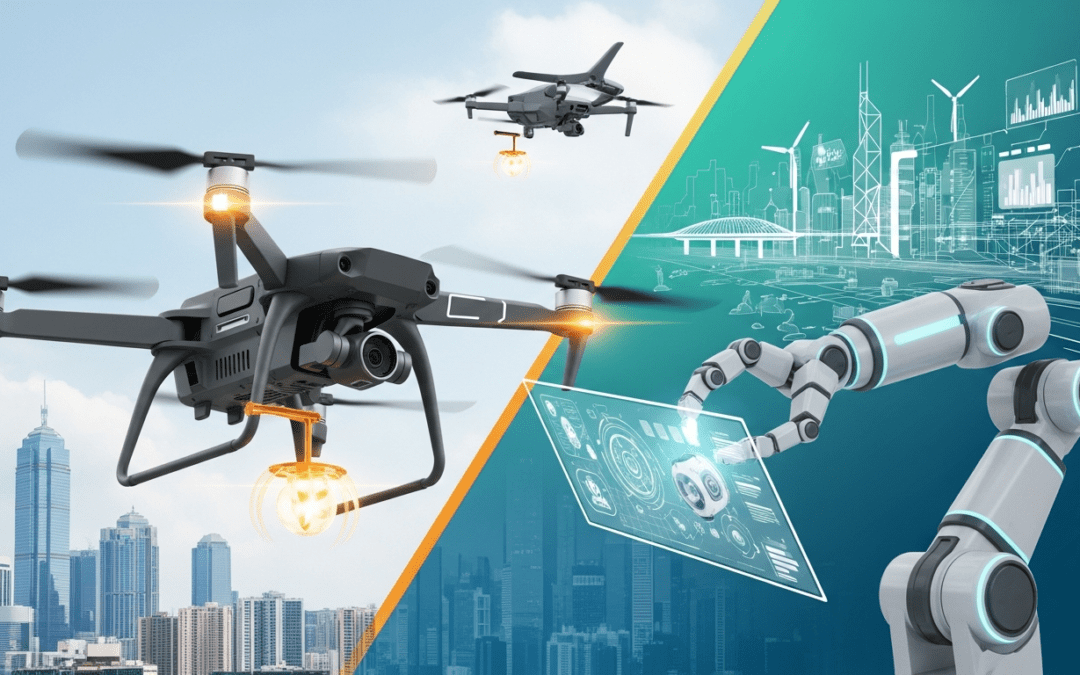
The early development of the drone industry was largely centered on the aircraft itself. Manufacturers competed to build platforms that could fly longer, carry heavier payloads, transmit higher-resolution imagery, and operate more reliably in diverse environments. In this phase, the drone was viewed primarily as a product.
Today, however, the industry is undergoing a profound transformation. The drone is increasingly becoming only one component within a much larger technological, economic, and operational ecosystem. As the sector matures, the greatest opportunities for growth, innovation, and value creation are shifting away from hardware manufacturing and toward the services, data, software, regulations, partnerships, and human capital that enable drone operations.
This evolution mirrors earlier developments in the personal computer, internet, and smartphone industries. While hardware remains essential, the greatest economic value increasingly resides in the ecosystem that surrounds the technology.
The future drone economy will therefore be shaped not only by aircraft manufacturers but also by training organizations, geospatial intelligence providers, artificial intelligence developers, regulatory specialists, data service companies, research institutions, and international partnerships.
The Commoditization of Drone Hardware
One of the primary reasons for this transition is the gradual commoditization of drone hardware.
Commercial drones have become increasingly affordable, reliable, and widely available. Manufacturing capabilities, particularly in China, have significantly reduced barriers to entry. As a result, many drone platforms now offer comparable levels of performance for common civilian applications.
This trend places pressure on manufacturers’ profit margins and shifts competitive differentiation toward:
- Software capabilities
- Data quality
- Operational expertise
- Customer support
- Specialized applications
- Integration services
In practical terms, a drone increasingly resembles a sensor platform rather than a standalone product. The true value emerges from the information it collects and the decisions that information enables.
Training: Building Human Capital
No drone ecosystem can function without skilled operators, instructors, mission planners, data analysts, and managers.
Training has become one of the fastest-growing segments of the drone economy because technological complexity continues to increase. Modern operators must understand:
- Aviation regulations
- Airspace management
- Risk assessment
- Mission planning
- Data collection
- Sensor operation
- Software processing
- Safety management
The emergence of advanced operations, including Beyond Visual Line of Sight (BVLOS), urban air mobility, autonomous systems, and drone swarms, will further increase the demand for specialized training.
Training organizations are therefore becoming strategic infrastructure providers within the drone ecosystem. Their role extends beyond certification to include professional development, operational readiness, and workforce creation.
Geospatial Intelligence: Turning Data into Knowledge
One of the most important commercial applications of drones is geospatial intelligence.
Drones generate enormous quantities of spatial information through:
- Photogrammetry
- LiDAR
- Multispectral imaging
- Thermal sensors
- High-resolution photography
However, raw data possesses little value until it is transformed into actionable intelligence.
Geospatial intelligence companies create value by converting drone-generated data into:
- Digital twins
- Terrain models
- Infrastructure assessments
- Agricultural insights
- Environmental monitoring products
- Urban planning tools
In many industries, clients are not purchasing drone flights. They are purchasing information.
This distinction is critical because it shifts the business focus from aircraft operation toward knowledge generation.
Artificial Intelligence: The New Competitive Frontier
Artificial Intelligence is becoming the most transformative force within the drone ecosystem.
AI technologies increasingly support:
- Autonomous navigation
- Object recognition
- Target identification
- Predictive maintenance
- Infrastructure inspection
- Agricultural analysis
- Environmental monitoring
The future competitive advantage of many drone operators will not depend on flying skills but on their ability to extract insights from large datasets.
As AI capabilities improve, drones will evolve from remote-controlled aircraft into autonomous information-gathering systems capable of supporting complex decision-making processes.
The integration of AI with drone operations may ultimately generate greater economic value than the aircraft themselves.
U-Space Integration: Creating the Air Traffic System of the Future
One of the most important challenges facing the drone industry is the integration of unmanned aircraft into controlled airspace.
Europe’s U-space initiative seeks to create a digital traffic management environment that enables safe coexistence between:
- Commercial aircraft
- General aviation
- Emergency services
- Unmanned systems
The future drone economy requires:
- Digital airspace services
- Real-time tracking
- Electronic identification
- Automated authorization
- Traffic deconfliction systems
As drone operations expand, U-space service providers may become as important as traditional air traffic management organizations.
The development of these infrastructures represents a major growth opportunity across Europe and beyond.
Regulatory Compliance: The Foundation of Trust
Unlike many digital technologies, drones operate within physical environments that directly affect public safety.
Consequently, regulatory compliance is not merely a legal requirement; it is a competitive necessity.
Organizations increasingly require expertise in:
- EASA regulations
- Risk assessments
- SORA methodologies
- Data protection
- Privacy management
- Operational authorizations
- Safety management systems
As operations become more complex, regulatory specialists will become indispensable participants within the drone ecosystem.
The ability to navigate regulatory environments may become a significant competitive advantage.
Data Services: The Emerging Core Business Model
The most successful drone companies of the future may not identify themselves as drone companies at all.
Instead, they may define themselves as:
- Data companies
- Intelligence providers
- Analytics organizations
- Digital infrastructure partners
This shift reflects a broader transformation from product-centric business models to service-centric business models.
Examples include:
- Precision agriculture platforms
- Infrastructure monitoring services
- Environmental intelligence providers
- Energy-sector inspection systems
- Logistics optimization platforms
In these cases, drones serve as data collection tools within larger information ecosystems.
The customer ultimately purchases insights rather than flight operations.
International Partnerships and Innovation Ecosystems
Perhaps the most underestimated component of the future drone economy is international cooperation.
The complexity of modern drone applications increasingly requires collaboration among:
- Governments
- Universities
- Research centers
- Technology firms
- Infrastructure operators
- Regulatory authorities
- International organizations
No single actor possesses all the capabilities necessary to address technological, regulatory, operational, and societal challenges simultaneously.
Innovation ecosystems therefore become critical.
Successful ecosystems depend upon:
- Trust
- Communication
- Strategic alignment
- Knowledge sharing
- Negotiation
- Partnership management
In this context, international collaboration becomes a force multiplier for innovation.
The most successful drone clusters of the future will likely be those capable of integrating diverse stakeholders into coherent frameworks of cooperation.
The Strategic Implications
The evolution of the drone economy reveals an important lesson.
The aircraft itself is becoming only one element within a broader value chain.
The highest-growth sectors increasingly include:
- Training and education
- Geospatial intelligence
- Artificial intelligence
- U-space services
- Regulatory consulting
- Data analytics
- International project management
- Research and development partnerships
This shift has significant implications for professionals entering the sector.
Future leaders in the drone economy will not necessarily be the best pilots. They will be the individuals capable of connecting technology, data, regulation, education, and cooperation into integrated solutions.
The drone industry is entering a new phase of maturity. While aircraft technology will continue to improve, the greatest opportunities for value creation are increasingly migrating beyond the aircraft itself.
The future belongs to the ecosystem.
Training organizations will create human capital. Geospatial intelligence firms will transform data into knowledge. Artificial intelligence will unlock new operational capabilities. U-space systems will enable safe airspace integration. Regulatory specialists will build trust and legitimacy. Data service providers will create new business models. International partnerships will accelerate innovation and market development.
The drone economy of the next decade will therefore be defined not by the aircraft alone, but by the complex network of technologies, institutions, skills, and relationships that surround it. Those organizations capable of orchestrating these ecosystems will become the true leaders of the unmanned aviation revolution.
Source: Open Sources Analysis, Relative Data Analysis by Nikos Chatzis
© 2026 Nikolaos Chatzis – negotiation.gr. All Rights Reserved. No part of this publication may be reproduced, distributed, or transmitted without prior written permission, except for brief quotations with proper attribution.